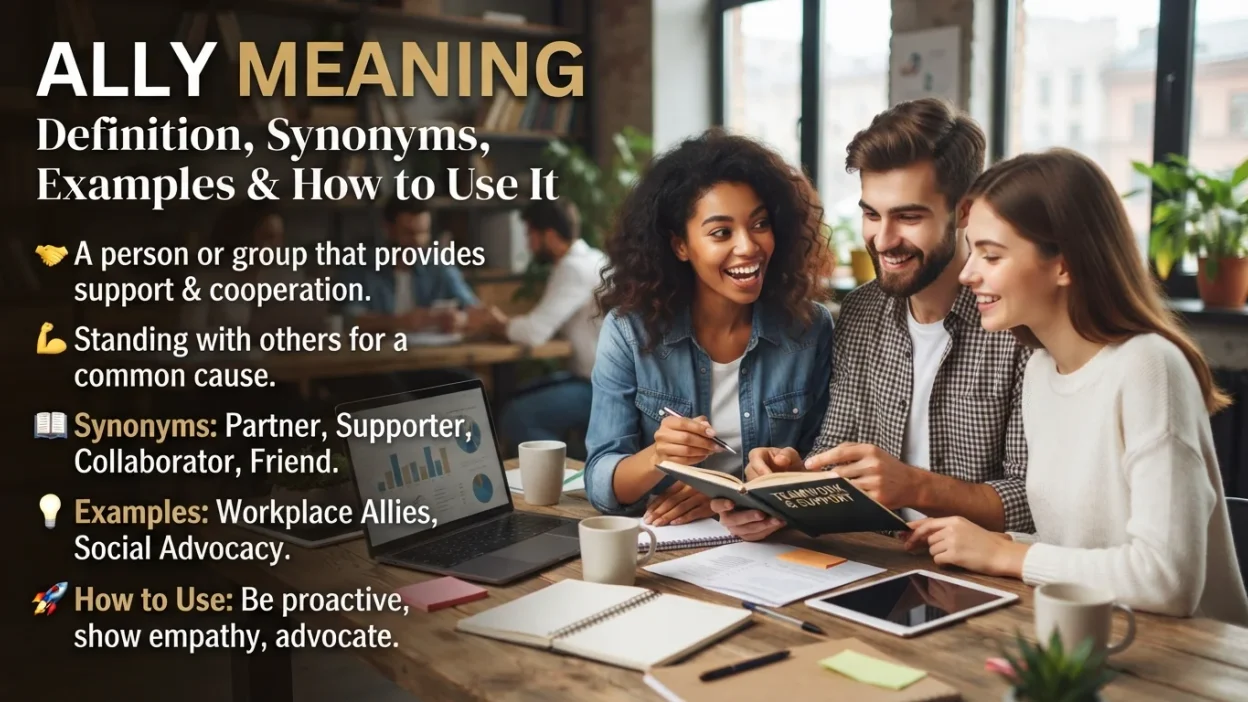
The word ally carries two distinct but related meanings that shape how people use it today. In its traditional sense, an ally is a person, group, or nation that provides help and support to another, often in a struggle or conflict . In modern social and cultural contexts, the term has taken on a more specific meaning: a person who actively supports a marginalized group without being a member of that group, particularly in LGBTQ+ and social justice spaces . Understanding which meaning applies depends on the situation and the relationship between the people involved.
What Does Ally Mean?
At its core, an ally is someone who joins with another for mutual benefit or support. The word functions as both a noun (a person or entity that allies with another) and a verb (to ally oneself with someone or something) . In everyday conversation, calling someone an ally signals that they are on your side, offering assistance, cooperation, or solidarity.
The traditional definition covers several contexts. In international relations, an ally is a nation bound to another by treaty or agreement, such as the United States and its NATO allies . In personal or professional life, an ally can be a colleague, friend, or associate who supports your goals or stands with you during a challenge . The common thread is a relationship of support and cooperation.
Ally as a Verb
When used as a verb, ally means to unite or form a connection with someone or something. It typically appears with the prepositions “with” or “to.” For example, “She allied herself with the reform movement” or “The small country allied itself to a larger power for protection” . This usage emphasizes the action of forming a bond or partnership.
Ally in Social Justice and LGBTQ+ Contexts
In recent decades, ally has acquired a more specific and culturally significant meaning. An ally is now commonly understood as someone who supports a marginalized or mistreated group without belonging to that group themselves . This usage is especially prominent in LGBTQ+ communities, where a straight or cisgender ally advocates for equal rights and inclusion .
The term extends beyond LGBTQ+ advocacy. Allies also support racial justice movements, disability rights, and other causes where people outside the affected community choose to stand in solidarity . Being an ally in this sense involves more than passive agreement. It requires active learning, listening, and a willingness to use one’s position to amplify marginalized voices .
What Makes Someone an Ally?
An effective ally does not simply claim the label. Instead, allyship is demonstrated through actions and attitudes. This includes educating oneself about the issues a community faces, speaking out against discrimination, and making space for marginalized people to be heard . Importantly, an ally acknowledges that they do not speak for the group they support; they work alongside its members.
Examples of Ally in Everyday Use
The following examples show how ally appears in different contexts, from casual conversation to formal writing.
Example 1 (Traditional support):
“When the company proposed budget cuts to the research department, the marketing director became an unexpected ally in the fight to preserve funding.” Here, ally refers to someone who lends support to a cause or group facing opposition .
Example 2 (International relations):
“The president met with key allies to discuss the new trade agreement.” In this context, allies are nations with formal cooperative relationships .
Example 3 (Social justice):
“As a straight ally, he attends Pride events and donates to LGBTQ+ youth organizations.” This usage reflects the modern, community-focused meaning .
Example 4 (Verb form):
“The neighborhood association allied itself with local businesses to oppose the construction project.” The verb form shows the act of forming a partnership for a shared goal .
Ally vs. Similar Terms: What’s the Difference?
Several words overlap with ally, but each carries distinct nuances. Understanding these differences helps you choose the right term.
| Term | Meaning | Typical Context | Tone |
|---|---|---|---|
| Ally | Someone who supports or cooperates with another; in social justice, an outside supporter of a marginalized group | Personal, political, international, advocacy | Supportive, cooperative |
| Advocate | Someone who publicly pleads or argues for a cause | Legal, political, social | Active, vocal |
| Supporter | Someone who approves of or encourages a person or cause | General, casual | Neutral to positive |
| Accomplice | In social justice, someone who actively works to dismantle systems of oppression, often at personal risk | Activist, racial justice | Radical, action-oriented |
An advocate speaks up for a cause, while an ally stands with the people affected. A supporter may offer encouragement without direct involvement. The term accomplice, used in some racial justice spaces, pushes further than ally by emphasizing direct action against oppressive systems rather than symbolic solidarity.
Common Misunderstandings About Ally
One frequent misconception is that being an ally is a self-appointed identity. In practice, allyship is recognized through consistent action and accountability to the community being supported, not simply through self-labeling . Another misunderstanding treats allyship as passive. True allyship involves ongoing learning, self-reflection, and a willingness to accept feedback, including when one makes mistakes .
A third confusion arises between the traditional and modern meanings. In a political or military discussion, calling a country an ally has nothing to do with social justice. Similarly, in a casual conversation about teamwork, “ally” may simply mean a helpful colleague. Context determines which meaning applies.
Is Ally Formal or Informal?
Ally is a standard English word appropriate for both formal and informal contexts. In academic writing, journalism, and professional communication, the term appears frequently, especially in political and social analysis. In casual conversation, people might say “He’s my ally on this project” or “She’s been a real ally to the community” without any special formality. The social justice usage has become mainstream enough to appear in corporate diversity statements and institutional policies .
How to Use Ally Correctly
Using ally accurately depends on the context you want to convey. If you mean a nation or group that cooperates with another, the traditional definition applies. If you are discussing support for a marginalized community, the social justice meaning is appropriate. In either case, the word implies a relationship of support and some degree of commitment or cooperation.
When describing someone as an ally to a specific community, it is respectful to acknowledge that the term carries weight and responsibility. Avoid using “ally” as a casual compliment if the person has not demonstrated sustained support. Similarly, in international or political contexts, “ally” denotes a formal or strategic relationship, not merely a friendly acquaintance.
FAQs
What does ally mean in simple terms?
An ally is someone who supports or cooperates with another person, group, or nation. In modern social contexts, it often refers to someone outside a marginalized group who actively supports that group’s rights and well-being.
What does it mean to be an ally to someone?
Being an ally means offering support, standing in solidarity, and taking action to help someone or a community, especially when they face challenges or discrimination. It involves listening, learning, and using your position to assist others.
Can ally be used as a verb?
Yes. To ally means to unite or form a connection with someone or something, usually followed by “with” or “to.” For example: “They allied themselves with the opposition.”
Is ally the same as advocate?
They are related but not identical. An advocate publicly speaks out for a cause or person, while an ally provides support and solidarity, often working alongside the affected group rather than speaking for them.
How is ally used in the LGBTQ+ community?
In LGBTQ+ contexts, an ally is typically a heterosexual or cisgender person who supports and advocates for LGBTQ+ rights and inclusion, working in partnership with the community rather than as a member of it.
What is the difference between ally and accomplice?
In social justice language, an ally supports a marginalized group from a position of relative privilege, while an accomplice takes active steps to challenge oppressive systems, sometimes at personal risk. The distinction emphasizes action and sacrifice over symbolic support.
Conclusion
The meaning of ally depends on where and how it is used. In its broadest sense, an ally is anyone who provides support or cooperation, whether a friend, colleague, or nation. In modern social justice language, the term carries a deeper commitment: a person who stands with a marginalized community, learns from its members, and works to advance equity. By paying attention to context, you can use and interpret “ally” accurately, whether you are discussing international relations, workplace collaboration, or advocacy for social change.

Emily Carter is a passionate writer who enjoys creating engaging, informative and easy-to-read content for a wide audience. She focuses on delivering helpful insights and fresh ideas that inform, inspire and connect with readers.