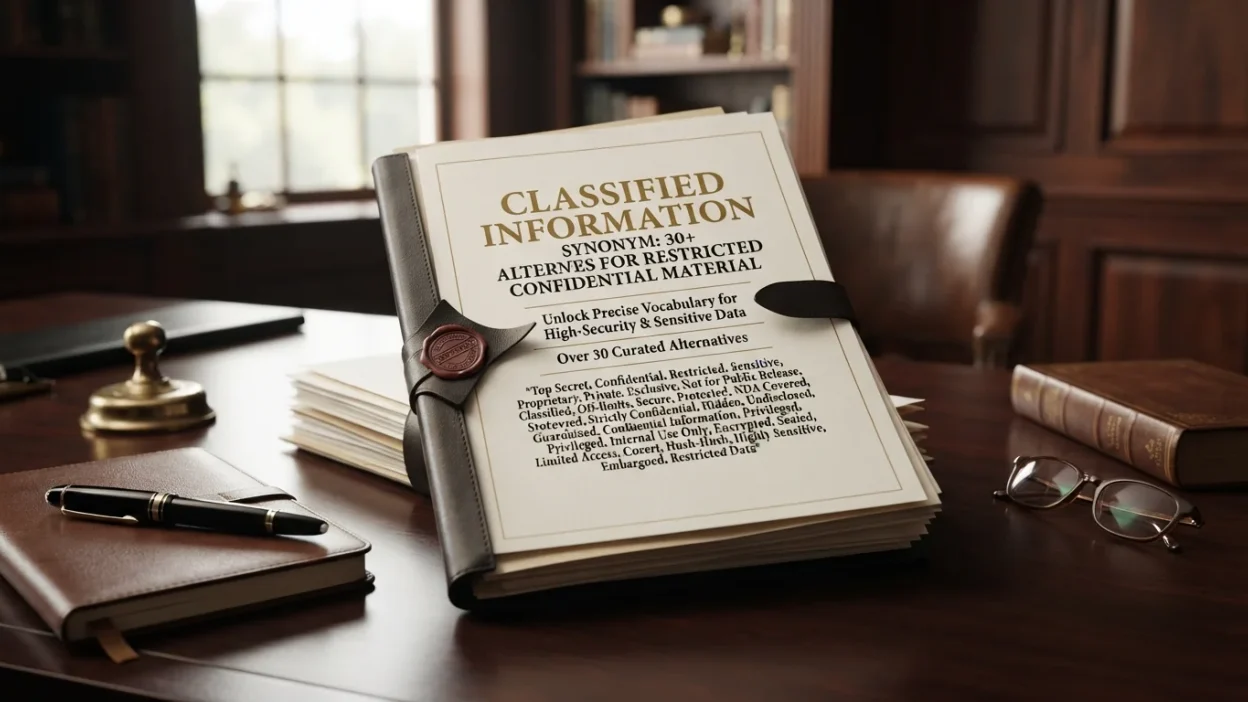
Classified information is a phrase with a precise legal weight in government contexts, but it also has broader everyday meanings that call for different synonyms. Choosing the right alternative depends on whether you are describing national-security material, a business secret, or simply information kept out of public view.
This guide explains what classified information means, how its tone and precision shift across contexts, and which synonyms work best in formal, professional, and everyday writing. You will find clear definitions, original examples, and a comparison table to help you select the most accurate word every time.
📖 What Does “Classified Information” Mean?
However, this looser meaning loses the legal precision of the government definition. A confidential business memo is not “classified” in the official sense, even though both terms involve restricted access.
🎭 Connotation and Tone: Neutral, Official, or Dramatic
Classified information is neutral and formal in official contexts. It carries an air of authority and legal seriousness. When journalists or commentators use the phrase, it can sound dramatic or even ominous, suggesting secrets of national importance.
In business or personal writing, using “classified” for ordinary private matters can sound inflated or misleading. A more modest alternative like confidential information or private information usually fits better. The tone of the phrase therefore depends heavily on whether the context is genuinely governmental.
🏛️ Origin and Etymology
The word classified comes from the verb classify, which entered English in the late 18th century from the French classifier, meaning to arrange in classes. The modern sense of “classified information” developed in the 20th century alongside the growth of government security systems. By the mid-20th century, executive orders and regulations formalized the three-tier system of Top Secret, Secret, and Confidential that remains in use today .
🗣️ Pronunciation
- American English IPA: /ˈklæsəfaɪd ˌɪnfərˈmeɪʃən/
- British English IPA: /ˈklæsɪfaɪd ˌɪnfəˈmeɪʃən/
- Syllables: classified (three) + information (four)
- Simple guide: “KLASS-uh-fyd in-fur-MAY-shun”
The primary stress falls on the first syllable of classified and on the third syllable of information.
🧩 Word Formation and Grammar
Classified is an adjective formed from the verb classify plus the suffix *-ed*. It functions as a participial adjective and typically precedes a noun (“classified documents,” “classified material”). The noun phrase classified information is uncountable, so it takes a singular verb (“The classified information was leaked”).
Related forms include classification (the process or system), classify (the verb), and declassify (to remove classification). The word can also appear in compound nouns such as classified ads, where the meaning is entirely different—advertisements arranged by category.
📚 Synonyms and Their Meanings
The alternatives below range from precise official terms to broader expressions for hidden or protected material.
1. Restricted Information
Meaning: Information whose access is limited to authorized individuals.
Example: The agency shared only restricted information with the contractor.
Usage: Formal and close in meaning; often implies a specific access control rather than a formal classification level.
2. Confidential Information
Meaning: Information entrusted to someone with the expectation of privacy.
Example: All confidential information in the file must be redacted before release.
Usage: Common in business, legal, and medical contexts. Note that “Confidential” is also one official U.S. classification level, but the phrase is broader than the government term .
3. Secret Information
Meaning: Information kept hidden from others.
Example: The spies exchanged secret information in a coded message.
Usage: General and direct; less precise than classified but widely understood.
4. Sensitive Information
Meaning: Information that requires careful handling due to privacy or security concerns.
Example: The help desk is trained to handle sensitive information with discretion.
Usage: Common in data protection and security writing; does not necessarily imply formal classification.
5. Privileged Information
Meaning: Information protected from disclosure by a legal privilege.
Example: Attorney-client privileged information cannot be subpoenaed in most cases.
Usage: Strictly legal; not a general substitute for classified.
6. Top-Secret Information
Meaning: Information at the highest level of official classification.
Example: The satellite images were labeled top-secret information.
Usage: Accurate only for the highest tier; not a general synonym for all classified material .
7. Nonpublic Information
Meaning: Information not made available to the general public.
Example: The company policy prohibits trading on nonpublic information.
Usage: Neutral and formal; broader and milder than classified.
8. Official Secrets
Meaning: Government information protected by law from disclosure.
Example: The journalist was accused of publishing official secrets.
Usage: Common in British English and journalism; implies legal protection.
9. Covert Information
Meaning: Information related to hidden or secret operations.
Example: The report contained covert information about intelligence activities.
Usage: Often describes methods or operations rather than documents; formal and slightly dramatic .
10. Clandestine Information
Meaning: Information connected to secret or illicit activity.
Example: The investigation uncovered clandestine information about the network.
Usage: Formal and literary; suggests secrecy with an edge of illegality or intrigue .
11. Undisclosed Information
Meaning: Information that has not been revealed.
Example: The settlement included undisclosed information about the terms.
Usage: Neutral and legalistic; does not imply a formal security label.
12. Private Information
Meaning: Personal or internal information not intended for public view.
Example: The form asks for private information such as your home address.
Usage: Common in privacy contexts; not suitable for national-security material.
13. Internal Information
Meaning: Information intended only for members of an organization.
Example: The memo was marked internal information and not for distribution.
Usage: Business and organizational contexts; mild and neutral.
14. Proprietary Information
Meaning: Information owned by a company and protected as a trade secret or competitive asset.
Example: The engineer signed an agreement not to share proprietary information.
Usage: Business and legal; specific to ownership and commercial value.
15. Sealed Information
Meaning: Information formally closed off from public access by a court or authority.
Example: The judge ordered the sealed information to remain private.
Usage: Legal and judicial contexts; narrower than classified.
16. Off-the-Record Information
Meaning: Information given informally and not for publication.
Example: The official provided off-the-record information to the reporter.
Usage: Journalism and informal professional contexts; not a security category.
17. Hush-Hush Information
Meaning: Information kept very secret (informal).
Example: The project was hush-hush information known only to the director.
Usage: Informal and conversational; unsuitable for formal writing.
18. Under-Wraps Information
Meaning: Information kept hidden or not yet revealed (informal).
Example: The details of the merger remain under-wraps information.
Usage: Informal and idiomatic; common in journalism and conversation.
19. Sealed Records
Meaning: Official documents closed to public inspection.
Example: The sealed records will not be opened for fifty years.
Usage: Legal and archival; refers specifically to documents rather than abstract information.
20. Protected Information
Meaning: Information shielded from disclosure by law or policy.
Example: Protected information includes health records and financial data.
Usage: Broad and formal; covers privacy, security, and legal protections.
21. Guarded Information
Meaning: Information kept carefully secret or controlled.
Example: The family kept guarded information about the inheritance.
Usage: Somewhat literary; suggests deliberate concealment.
22. Confidential Material
Meaning: Documents or data treated as confidential.
Example: The auditor reviewed confidential material in a secure room.
Usage: A close variant of confidential information; slightly more concrete.
23. Sensitive Material
Meaning: Material requiring careful handling for security or privacy reasons.
Example: The courier was trained to transport sensitive material.
Usage: Common in security and logistics; similar to sensitive information.
24. State Secrets
Meaning: Government information whose disclosure would harm national security.
Example: The lawsuit was dismissed because it involved state secrets.
Usage: Formal and legal; often used in national-security law and journalism.
25. National-Security Information
Meaning: Information related to the defense or foreign relations of a country.
Example: The committee has oversight of national-security information.
Usage: Formal and precise; the category under which classified information usually falls .
26. Secure Information
Meaning: Information protected by security measures.
Example: The server stores secure information behind multiple firewalls.
Usage: Often used in cybersecurity; can imply technical protection rather than classification.
27. Coded Information
Meaning: Information written in code or cipher.
Example: The message contained coded information that required a key.
Usage: Technical and specific; not a synonym for classified in the legal sense.
28. Encrypted Information
Meaning: Information converted into a form that prevents unauthorized reading.
Example: The app protects encrypted information with end-to-end security.
Usage: Technical; describes a method of protection rather than a legal status.
29. Hidden Information
Meaning: Information deliberately kept out of sight or knowledge.
Example: The detective found hidden information in the margins of the letter.
Usage: General and neutral; very broad.
30. Concealed Information
Meaning: Information kept secret or covered up.
Example: The audit revealed concealed information about the transactions.
Usage: Slightly more formal than hidden; can imply deliberate deception.
📊 Synonym Comparison Table
| Synonym | Meaning | Tone or Context | Example |
|---|---|---|---|
| Restricted information | Access limited to authorized people | Formal; official | The agency shared restricted information. |
| Confidential information | Private information entrusted to someone | Business, legal, medical | All confidential information must be redacted. |
| Sensitive information | Information requiring careful handling | Security, privacy | Handle sensitive information with discretion. |
| Top-secret information | Highest official classification | Government; specific | The satellite images were top-secret. |
| Official secrets | Government information protected by law | British, journalistic | The journalist published official secrets. |
| Proprietary information | Company-owned trade secret | Business, legal | She signed an agreement about proprietary information. |
| Privileged information | Legally protected from disclosure | Legal | Attorney-client privileged information is protected. |
| Nonpublic information | Not available to the public | Neutral, formal | Trading on nonpublic information is illegal. |
| State secrets | Government information harmful to disclose | Legal, national security | The case involved state secrets. |
| Under-wraps information | Kept hidden (informal) | Informal, conversational | The merger details remain under wraps. |
🎯 How to Choose the Right Synonym
Start with the legal status. If you are describing material covered by a government classification system, use classified information, restricted information, or national-security information. Do not substitute confidential information unless you are sure the context is general rather than official, because “Confidential” is a specific lower classification level .
Consider formality. Official secrets and state secrets are formal and journalistic. Hush-hush and under wraps are informal and conversational. Using an informal alternative in a formal document can undermine your credibility.
Check the intensity. Top-secret information is the strongest and most specific. Sensitive information is milder and broader. Hidden information is the most general and carries no official weight.
🔗 Related Words and Word Forms
- Classification (noun): The system or process of assigning security levels.
- Classify (verb): To designate information as classified.
- Declassify (verb): To remove classified status from information.
- Clearance (noun): Official authorization to access classified information.
- Need-to-know (noun/adjective): The principle that access is limited to those who require it for their work.
- Compartmentalization (noun): The practice of limiting access to specific pieces of classified information.
⚖️ Antonyms
- Public information: Information available to anyone. Example: The agency released the public information after the review.
- Unclassified information: Information not assigned a security classification. Example: The report contained only unclassified information.
- Open-source information: Information freely available from public sources. Example: The analyst relied on open-source information.
- Declassified information: Information formerly classified but now released. Example: The declassified information revealed the program’s history.
- Overt information: Information that is open and not hidden. Example: The overt information was published on the website.
⚠️ Common Mistakes to Avoid
Treating “confidential” as a universal substitute. In government usage, Confidential is only the lowest of three classification levels. Calling Top Secret material “confidential” is inaccurate and could be misleading .
Using “classified” for ordinary private matters. A personal diary is not classified information. Using the phrase for everyday privacy sounds inflated and confuses the term’s legal meaning.
Confusing “secret” with “classified.” All classified information is secret in a general sense, but not all secret information is classified. A surprise party is secret but not classified.
Ignoring the difference between information and documents. Sealed records refers to documents, not abstract information. Choose the synonym that matches what you are actually describing.
Assuming “proprietary” means “classified.” Proprietary information is owned by a company and protected commercially. It is not government-classified material.
❓ Frequently Asked Questions
What is the closest synonym for classified information?
Restricted information is the closest formal synonym in general usage. In official U.S. contexts, national-security information is the broader category under which classified information falls .
What is a formal alternative to classified information?
Restricted information, sensitive information, and national-security information are all formal alternatives. Choose based on whether you want to emphasize access control, handling care, or the security domain.
What is an informal alternative to classified information?
Hush-hush information and under-wraps information are informal alternatives. Secret information is slightly less informal but still conversational. None of these carries the legal weight of the original phrase.
What is the opposite of classified information?
Unclassified information is the direct opposite in government usage. Public information and open-source information are broader opposites that describe material available to anyone.
Can “confidential information” replace “classified information”?
Only in general, non-governmental contexts. In official U.S. security usage, Confidential is one specific classification level, not a synonym for the entire system . Using it as a blanket replacement can be imprecise.
What are the three levels of classified information?
The three standard levels in the U.S. system are Top Secret, Secret, and Confidential. Top Secret applies to information whose disclosure could cause exceptionally grave damage; Secret applies to serious damage; Confidential applies to damage .
Is “top-secret information” a synonym for classified information?
It is a narrower term. Top-secret information refers only to the highest classification level. All top-secret information is classified, but not all classified information is top-secret .
Which synonym works best in business writing?
Confidential information or proprietary information works best in business writing. These terms accurately describe private commercial material without implying a government security classification.
✨ Conclusion
Classified information is a phrase that demands precision. In government and legal writing, its synonyms should respect the formal three-tier system of Top Secret, Secret, and Confidential. In business, legal, and everyday contexts, broader alternatives like confidential information, sensitive information, and proprietary information are more accurate and natural.
The best classified information synonym is the one that matches your context, your audience, and the level of legal weight you need. Use the official terms when precision matters, and use the broader terms when you are describing privacy rather than national security. With the right word, your meaning will be clear—and appropriately guarded.

Emily Carter is a passionate writer who enjoys creating engaging, informative and easy-to-read content for a wide audience. She focuses on delivering helpful insights and fresh ideas that inform, inspire and connect with readers.