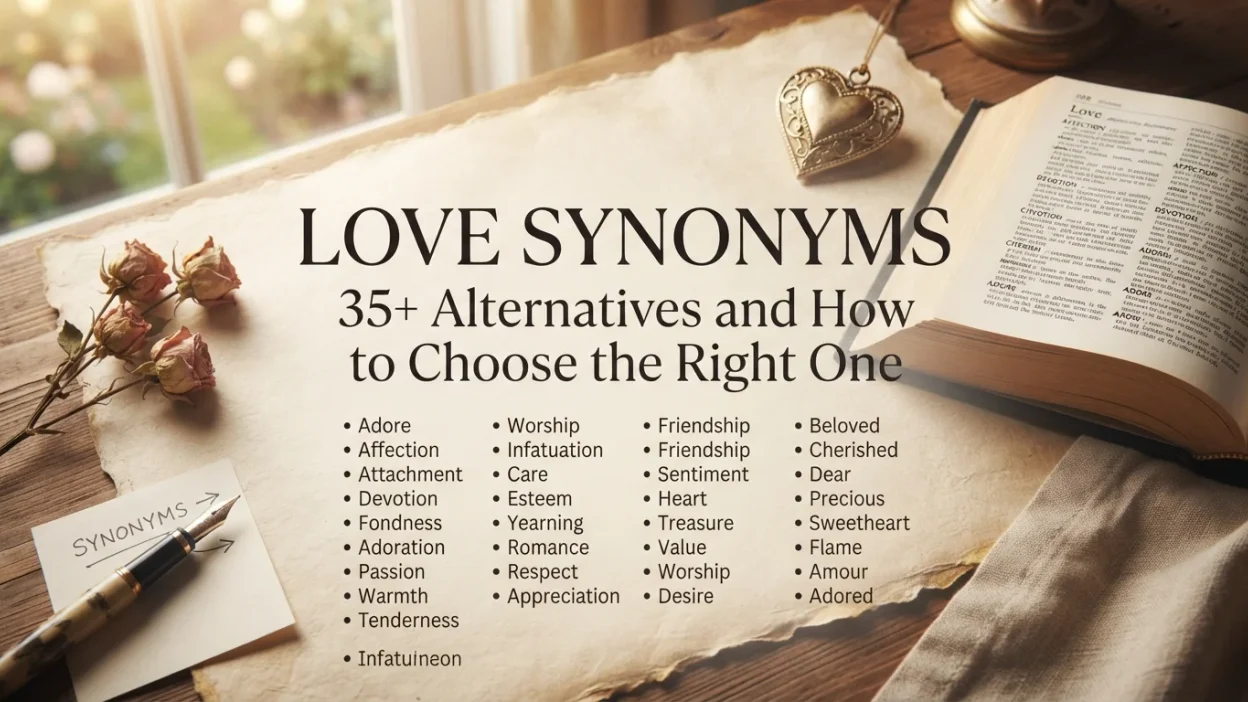
Synonyms for love is one of the most powerful words in English, and also one of the most elastic. We use it for romantic partners, family members, close friends, favorite foods, and songs we cannot stop playing. That range is what makes the word so useful—and so easy to flatten. If you are looking for a love synonym, you have probably sensed that a more precise word would carry more weight. This guide explains what love means, offers 35+ accurate alternatives, and shows you how to pick the right one for your context.
What Does “Love” Mean? 📖
Love is a noun and a verb describing deep affection, attachment, or strong liking. As a noun, it can refer to a feeling (“her love for her children”), a person (“my love”), or an enthusiasm (“a love of music”). As a verb, it means to feel deep affection for someone or to enjoy something greatly.
The word spans an enormous range. At its deepest, it describes romantic devotion or lifelong family bonds. At its lightest, it describes a strong preference: “I love this restaurant.” Both uses are natural, but they carry very different emotional weight.
Connotation and Tone 🎭
Love is strongly positive and emotionally powerful. In romantic and family contexts, it carries seriousness and depth. In casual contexts, it can be warm but light.
The word’s flexibility is both a strength and a weakness. Because love covers so much, it can sound generic when used carelessly. Saying “I love pizza” and “I love my partner” uses the same word for very different feelings, and careful writers often choose a more specific word to make the distinction clear.
Love can also carry vulnerability. Declaring love is a significant act in most cultures, and the word retains that weight even in casual writing.
Origin and Etymology 📜
Love comes from the Old English lufu, a noun meaning deep affection, and the related verb lufian. It is a Germanic word with cognates across Northern Europe, including the Old Frisian luve and the Old High German luba.
The word has been in continuous use for over a thousand years. Its core meaning of deep affection has remained remarkably stable, though its range of application has expanded to include enthusiasms and preferences. Related forms include lovely, loving, beloved, and lovable.
Pronunciation 🗣️
- American English IPA: /lʌv/
- British English IPA: /lʌv/
- Syllable Count: One syllable
- Simple Pronunciation Guide: luv (rhymes with dove and glove)
The vowel is short and open. The final *v* is voiced, which distinguishes it from the unvoiced *f* in words like luff.
Word Formation and Grammar ✍️
Love functions as both a noun and a verb. As a noun, it can be countable (“a love of music”) or uncountable (“love is patient”). As a verb, it is transitive: “She loves her family.”
The adjective forms include loving (showing affection), lovable (easy to love), beloved (dearly loved), and lovely (delightful or beautiful). The adverb lovingly means “with affection.” The negative forms loveless and unloved describe the absence of love.
Common phrases include fall in love, in love with, love at first sight, and labor of love.
35+ Synonyms and Their Meanings 📚
The following alternatives each capture a different shade of love. Choose based on intensity, type of relationship, and tone.
1. Affection
Meaning: A gentle feeling of fondness or liking.
Example: She felt deep affection for her childhood friends.
Usage: Warmer and softer than love. Often used for family and friendship rather than romance.
2. Adoration
Meaning: Deep love and respect; worship.
Example: The crowd showed adoration for the retiring singer.
Usage: Strong and often public. Can imply hero worship.
3. Devotion
Meaning: Loyalty and deep commitment to a person or cause.
Example: His devotion to his patients earned him widespread respect.
Usage: Emphasizes loyalty and dedication, not just feeling.
4. Fondness
Meaning: Mild affection or liking.
Example: She has a fondness for old mystery novels.
Usage: Milder than love. Often about preferences and gentle affection.
5. Attachment
Meaning: Emotional bond or connection to someone or something.
Example: The child formed a strong attachment to her teacher.
Usage: Neutral and psychological. Often used in research and professional writing.
6. Passion
Meaning: Intense emotion, especially romantic or enthusiastic.
Example: Their passion for each other never faded.
Usage: Strong and often romantic or creative. Suggests intensity and fire.
7. Infatuation
Meaning: An intense but short-lived admiration or love.
Example: His infatuation with her faded within a few months.
Usage: Often implies shallow or temporary feeling. Can sound critical.
8. Obsession
Meaning: An unhealthy preoccupation with someone or something.
Example: His obsession with winning consumed his life.
Usage: Negative. Suggests loss of control.
9. Cherish
Meaning: To hold someone or something dear; to care for tenderly.
Example: She cherishes the letters her grandmother wrote.
Usage: Warm and tender. Emphasizes protection and value.
10. Treasure
Meaning: To value highly; to cherish.
Example: He treasures the time he spends with his children.
Usage: Warm and slightly literary. Emphasizes the preciousness of what is loved.
11. Adore
Meaning: To love and respect deeply; to worship.
Example: She adores her older sister.
Usage: Stronger than love. Common in casual speech for strong liking.
12. Worship
Meaning: To show reverence and adoration, often religious.
Example: He worships the ground she walks on.
Usage: Very strong. Can be romantic, religious, or hyperbolic.
13. Care For
Meaning: To feel concern and affection for someone.
Example: He cares for his aging parents with patience.
Usage: Gentle and practical. Often about responsibility alongside affection.
14. Hold Dear
Meaning: To value greatly; to cherish.
Example: She holds her family traditions dear.
Usage: Warm and slightly formal. Common in personal writing.
15. Be Fond Of
Meaning: To like or feel affection for.
Example: I’m very fond of my neighbors.
Usage: Mild and polite. Common in British English.
16. Have a Soft Spot For
Meaning: To have a special fondness for someone or something.
Example: She has a soft spot for stray cats.
Usage: Informal and warm. Suggests affectionate weakness.
17. Dote On
Meaning: To show excessive love or fondness for someone.
Example: Grandparents often dote on their grandchildren.
Usage: Warm but can imply overindulgence.
18. Yearn For
Meaning: To have an intense longing for someone or something.
Example: He yearned for the days when they were together.
Usage: Emphasizes longing and absence rather than present love.
19. Long For
Meaning: To have a strong desire or craving.
Example: She longed for the comfort of home.
Usage: Similar to yearn. Often about distance or loss.
20. Pining
Meaning: Suffering from longing, especially romantic.
Example: He spent months pining after his ex.
Usage: Literary and slightly melancholic.
21. Smitten
Meaning: Struck with strong romantic affection.
Example: He was smitten from their first conversation.
Usage: Informal and warm. Often about early romance.
22. Enamored
Meaning: Filled with love or admiration.
Example: She was enamored with the city’s charm.
Usage: Formal and literary. Can also mean charmed by something non-romantic.
23. Besotted
Meaning: Strongly infatuated; unable to think clearly because of love.
Example: He was completely besotted with the new teacher.
Usage: Informal and slightly humorous. Suggests loss of reason.
24. Lovestruck
Meaning: Overwhelmed by romantic love.
Example: The lovestruck teenagers held hands everywhere.
Usage: Informal and vivid. Often describes visible behavior.
25. Devoted
Meaning: Very loving and loyal.
Example: She is a devoted mother to her three children.
Usage: Emphasizes loyalty and consistency.
26. Affectionate
Meaning: Showing warmth and tenderness.
Example: He gave his daughter an affectionate hug.
Usage: Describes visible behavior rather than internal feeling.
27. Tender
Meaning: Gentle, caring, and loving.
Example: She gave him a tender look across the table.
Usage: Warm and gentle. Often about moments of care.
28. Warm
Meaning: Showing affection and friendliness.
Example: They gave us a warm welcome.
Usage: Milder and broader than love. Often about hospitality.
29. Close
Meaning: Having a strong emotional bond.
Example: The sisters have always been close.
Usage: Understated. Describes the relationship rather than the feeling.
30. Attached
Meaning: Emotionally connected to someone or something.
Example: He has become very attached to his new puppy.
Usage: Neutral and practical. Common in psychology and everyday speech.
31. Committed
Meaning: Devoted to a relationship or cause.
Example: They are committed to making the marriage work.
Usage: Emphasizes choice and effort rather than emotion alone.
32. Sweet On
Meaning: Informal; fond of, often romantically.
Example: Everyone could tell he was sweet on her.
Usage: Informal and slightly old-fashioned.
33. Carrying a Torch For
Meaning: Informal idiom; continuing to love someone after a relationship ends.
Example: He’s still carrying a torch for his college girlfriend.
Usage: Informal and melancholic.
34. Love-Struck
Meaning: Same as lovestruck; suddenly and deeply in love.
Example: The love-struck couple spent every free moment together.
Usage: Informal and vivid.
35. Ardent
Meaning: Passionate and enthusiastic.
Example: She is an ardent supporter of the arts.
Usage: Formal and literary. Often about enthusiasm rather than people.
Synonym Comparison Table 📊
| Synonym | Meaning | Tone or Context | Example |
|---|---|---|---|
| Affection | Gentle fondness | Warm, Family | Affection for old friends. |
| Adoration | Deep love and respect | Strong, Public | Adoration for a mentor. |
| Devotion | Loyal commitment | Strong, Loyal | Devotion to patients. |
| Fondness | Mild liking | Mild, Neutral | A fondness for old movies. |
| Passion | Intense emotion | Strong, Romantic | Passion for music. |
| Cherish | To hold dear | Warm, Tender | Cherish old letters. |
| Adore | To love deeply | Strong, Common | Adore her sister. |
| Smitten | Romantically struck | Informal, Warm | Smitten with someone new. |
| Enamored | Filled with love | Formal, Literary | Enamored with the city. |
| Besotted | Strongly infatuated | Informal, Humorous | Besotted with a new crush. |
| Devoted | Very loving and loyal | Warm, Steady | A devoted parent. |
| Smoldering | Strong, suppressed passion | Literary, Intense | A smoldering romance. |
How to Choose the Right Synonym 🎯
Start by asking what kind of love you mean.Consider the relationship. Devotion and cherish fit long-term bonds and family. Smitten, besotted, and infatuation fit early romance, though the last can sound dismissive.
Think about formality. In formal writing, devotion, ardent, and enamored sound more precise than love. In casual conversation, adore, dote on, and sweet on are natural.
Finally, check whether you need a synonym at all. Sometimes love is the clearest and most powerful word. Replacing it with a weaker synonym can drain the sentence of feeling.
Related Words and Word Forms 🔗
The noun love names the feeling. The adjective loving describes someone who shows affection. Lovely means delightful or beautiful. Beloved means dearly loved, often used in formal and literary contexts.
The verb love means to feel affection or enjoy greatly. Related concepts include romance, affection, attachment, and passion. The negative forms unloved and loveless describe the absence of love.
Antonyms of Love 🔄
These words describe hatred, indifference, or the absence of affection.
- Hate: Intense dislike or hostility. Example: He hated the way he was treated.
- Loathing: Strong disgust or hatred. Example: She looked at the offer with loathing.
- Detest: To dislike intensely. Example: I detest liars.
- Abhor: To regard with disgust and hatred. Example: He abhors violence.
- Indifference: Lack of interest or concern. Example: She greeted the news with indifference.
- Apathy: Lack of feeling or emotion. Example: The apathy of the crowd was disappointing.
Common Mistakes to Avoid ⚠️
The most common mistake is overusing love for everything from relationships to sandwiches. When love describes every preference, it stops signaling depth. Reserve it for things that genuinely matter.
Another mistake is confusing love with infatuation. Infatuation is intense but often temporary and shallow; love is deeper and usually more stable. Using them interchangeably can mislead your reader.
Be careful with intensity. Worship and obsession are very strong and can sound extreme. Fondness and attachment are much milder. Match the word to the actual feeling.
Finally, avoid using romantic synonyms in non-romantic contexts. Calling a friend “my beloved” or saying you are “smitten” with a colleague can send the wrong signal.
Frequently Asked Questions ❓
What does love mean?
Love describes deep affection, attachment, or strong liking. It can refer to romantic devotion, family bonds, friendship, or strong enthusiasm for something.
What is the closest synonym to love?
Affection is the closest gentle synonym. Devotion is close for loyal, long-term love. Adoration is close for intense, admiring love.
What is a formal alternative to love?
Devotion, ardent, and enamored are strong formal alternatives. Each carries a slightly different emphasis.
What is an informal alternative to love?
Adore, smitten, and dote on are common informal alternatives. Sweet on is informal and slightly old-fashioned.
What is the opposite of love?
Hate, loathing, and detest are common opposites. Indifference describes the absence of strong feeling rather than active hatred.
Can love be used in academic writing?
It can, but it is often too general. More precise words like attachment, affection, or devotion usually serve better in academic contexts, especially in psychology and sociology.
How does love differ from infatuation?
Love is deep, stable affection that usually grows over time. Infatuation is intense but often temporary and based on surface attraction. Infatuation can fade quickly; love tends to endure.
Which synonym works best in everyday conversation?
Adore and love itself remain natural. Dote on works well for family affection. Smitten is natural for early romance. Fond of is mild and polite.
Conclusion
Choosing the right love synonym depends on the type and intensity of the feeling. Affection and fondness capture gentle warmth. Devotion and cherish carry loyalty and tenderness. Passion and adoration convey intensity. Smitten and besotted describe the dizzy early stages of romance.
Above all, remember that love is a powerful word precisely because it is not interchangeable with anything else. When you do reach for a love synonym, match it to the real feeling you are describing, and your writing will carry the weight it deserves.

Emily Carter is a passionate writer who enjoys creating engaging, informative and easy-to-read content for a wide audience. She focuses on delivering helpful insights and fresh ideas that inform, inspire and connect with readers.