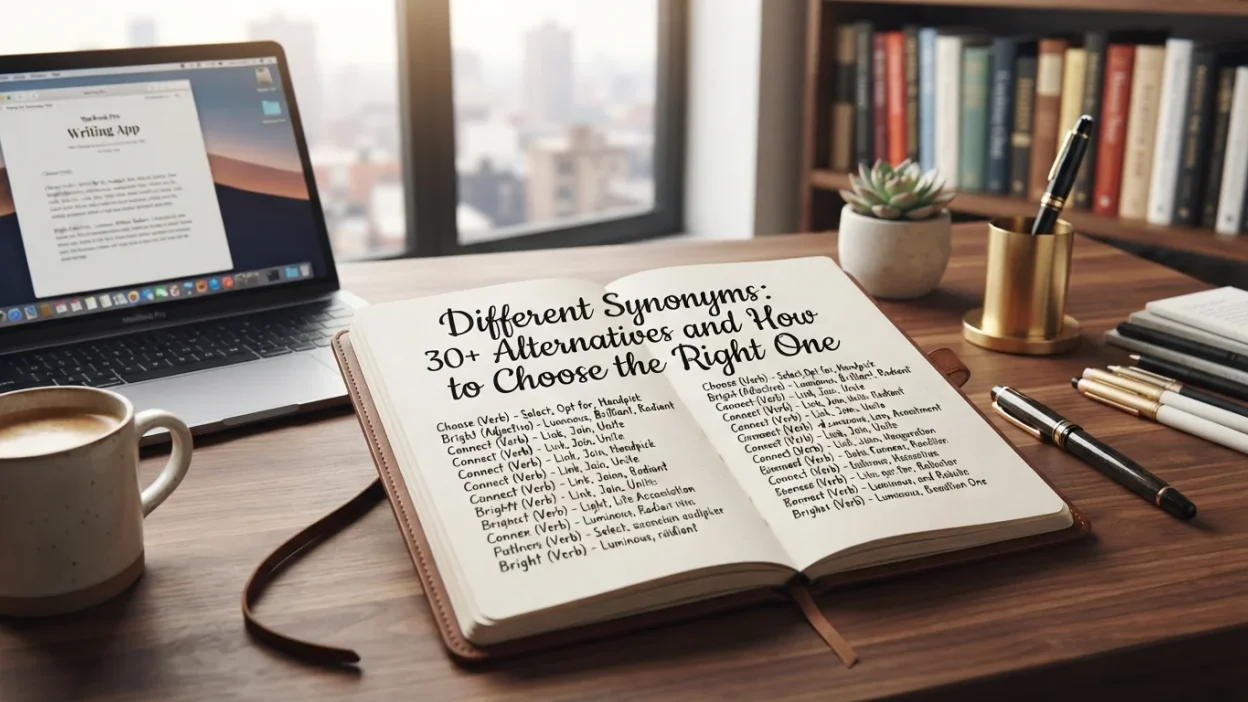
Synonyms for different is one of the most flexible adjectives in English, and that flexibility is exactly why it can feel flat. We use it for colors, opinions, people, and experiences, often without noticing how vague it has become. If you are looking for a different synonym, you have probably sensed that a sharper word would say more. This guide explains what different means, offers 30+ accurate alternatives, and shows you how to pick the right one for your context.
What Does “Different” Mean? 📖
Different is an adjective that describes something that is not the same as another thing. It can also mean distinct, separate, unusual, or various, depending on the sentence.
The word covers several related senses. The first is comparison: two things are different when they do not match. The second is distinctness: different people come from different backgrounds, meaning they are separate individuals. The third is unusualness: “She’s different” can mean she is unconventional or stands out from the crowd.
Connotation and Tone 🎭
Different is neutral in tone and register. It does not carry the warmth of unique or the criticism of strange. It simply signals that something is not the same.
That neutrality is useful, but it also makes the word easy to overuse. In formal writing, a more specific synonym often communicates more precisely. In casual speech, different remains perfectly natural, though it can sound vague without context.
The word can carry a slightly negative edge in certain contexts. “That’s a different look” can be a polite way of saying something is odd. Tone of voice and context usually make the meaning clear.
Origin and Etymology 📜
Different entered English in the late 14th century from the Latin differentem, the present participle of differre, meaning “to carry apart” or “to set apart.” The root ferre means “to carry,” so the underlying image is of two things being carried in separate directions.
The word is related to differ, difference, and differentiate. Its core meaning of separation and distinction has remained stable for over six centuries.
Pronunciation 🗣️
- American English IPA: /ˈdɪfərənt/
- British English IPA: /ˈdɪfrənt/
- Syllable Count: Three syllables (dif-fer-ent)
- Simple Pronunciation Guide: DIF-uh-ruhnt
The primary stress falls on the first syllable. In rapid speech, the middle syllable is often compressed, giving a sound close to “DIF-ruhnt.”
Word Formation and Grammar ✍️
Different is an adjective. It appears before nouns (“a different approach”) and after linking verbs (“the approach was different”). It is gradable, so it can be modified by adverbs: “very different,” “slightly different,” “completely different.”
The adverb form is differently: “She approached the problem differently.” The noun form is difference: “the difference between the two plans.” The verb differ means to be unlike or to disagree.
Different is typically followed by from in careful writing, though than and to are also used in different regions and registers. The noun form difference is often followed by between or in.
30+ Synonyms and Their Meanings 📚
The following alternatives each capture a different kind of difference. Choose based on what you want to emphasize: contrast, variety, uniqueness, or separation.
1. Distinct
Meaning: Clearly separate and different; not the same.
Example: The two proposals are distinct and should not be confused.
Usage: Formal. Emphasizes clear separation and recognizability.
2. Distinctive
Meaning: Characteristic of a particular person or thing; setting it apart.
Example: She has a distinctive voice that is easy to recognize.
Usage: Emphasizes the quality that makes something stand out.
3. Dissimilar
Meaning: Not alike; different in nature or form.
Example: The brothers have dissimilar temperaments.
Usage: Formal and technical. Often used in comparisons and research.
4. Unlike
Meaning: Different from; not similar to.
Example: Unlike her sister, she prefers quiet evenings at home.
Usage: Common and versatile. Often introduces a comparison.
5. Contrasting
Meaning: Noticeably different, especially when compared side by side.
Example: The report presented contrasting views from two experts.
Usage: Emphasizes visible or deliberate contrast.
6. Divergent
Meaning: Moving or extending in different directions; differing.
Example: The two studies reached divergent conclusions.
Usage: Formal. Often used for ideas, paths, or opinions.
7. Varied
Meaning: Showing a range of different types or elements.
Example: The festival offered a varied program of music and dance.
Usage: Emphasizes variety within a group or collection.
8. Diverse
Meaning: Showing a great deal of variety; very different from one another.
Example: The city has a diverse population from many backgrounds.
Usage: Common in social and professional contexts. Often about people or groups.
9. Various
Meaning: More than one; several different types.
Example: We received various responses to the survey.
Usage: Neutral and common. Often used before plural nouns.
10. Assorted
Meaning: Of various types; mixed.
Example: The box contained assorted buttons and beads.
Usage: Slightly informal. Often used for collections of small items.
11. Miscellaneous
Meaning: Consisting of various unrelated items or categories.
Example: The drawer was full of miscellaneous cables and chargers.
Usage: Formal and practical. Often used in lists and inventories.
12. Manifold
Meaning: Many and varied.
Example: The project faced manifold challenges.
Usage: Formal and slightly literary.
13. Heterogeneous
Meaning: Consisting of dissimilar elements; mixed.
Example: The class was heterogeneous in age and background.
Usage: Technical and formal. Common in social science and statistics.
14. Divergent
Meaning: Differing; moving apart.
Example: The committee was divided into divergent factions.
Usage: Formal. Often used for opinions and paths.
15. Alternative
Meaning: Available as another possibility; different from the usual.
Example: We need to consider alternative approaches.
Usage: Common in business and decision-making contexts.
16. Alternate
Meaning: Every other; or serving as a substitute.
Example: The team has alternate players ready for the final.
Usage: Note that alternate and alternative differ in careful usage. Alternate often means “every other,” while alternative means “another option.”
17. Separate
Meaning: Physically or conceptually apart; distinct.
Example: They keep their finances in separate accounts.
Usage: Emphasizes independence and division.
18. Disparate
Meaning: Essentially different in kind; not comparable.
Example: The study brought together disparate fields of research.
Usage: Formal. Often used for things that are hard to compare.
19. Discordant
Meaning: Disagreeing or incongruous; harsh in combination.
Example: The discordant colors clashed badly.
Usage: Often negative. Suggests a lack of harmony.
20. Unconventional
Meaning: Not based on or conforming to what is generally done.
Example: She took an unconventional route to success.
Usage: Positive or neutral. Often describes methods or lifestyles.
21. Unusual
Meaning: Not commonly occurring or seen.
Example: The shop sells unusual gifts you won’t find elsewhere.
Usage: Neutral. Emphasizes rarity rather than difference from a specific thing.
22. Unique
Meaning: Being the only one of its kind; unlike anything else.
Example: Each fingerprint is unique.
Usage: Strong and often overused. Technically means “one of a kind,” not merely “unusual.”
23. Peculiar
Meaning: Strange or odd; or belonging exclusively to someone.
Example: The house had a peculiar smell.
Usage: Can be negative (strange) or neutral (specific to). Context decides.
24. Odd
Meaning: Different from what is usual or expected.
Example: It was odd that no one answered the door.
Usage: Informal and often slightly negative.
25. Strange
Meaning: Unusual or surprising in a way that is unsettling.
Example: A strange noise came from the attic.
Usage: Common and neutral to negative. Often suggests mystery.
26. Novel
Meaning: New and original; not seen before.
Example: The team proposed a novel solution to the problem.
Usage: Formal and positive. Emphasizes newness rather than mere difference.
27. Fresh
Meaning: New and different; not stale or repetitive.
Example: The redesign gave the brand a fresh look.
Usage: Positive. Often about ideas, approaches, or appearances.
28. Other
Meaning: Different from the one already mentioned.
Example: The other option is to delay the launch.
Usage: Simple and common. Often used in comparisons.
29. Otherwise
Meaning: In a different way or circumstance.
Example: The plan was sound, but the timing was otherwise.
Usage: Adverb, not adjective, but useful for expressing difference in conditions.
30. A Far Cry From
Meaning: Very different from something else.
Example: The final product was a far cry from the original design.
Usage: Idiomatic and slightly informal.
31. Worlds Apart
Meaning: Extremely different from each other.
Example: Their views on the issue are worlds apart.
Usage: Idiomatic and vivid.
32. Like Night and Day
Meaning: Completely different.
Example: The new manager’s style is like night and day compared to the old one.
Usage: Informal idiom. Vivid and memorable.
Synonym Comparison Table 📊
| Synonym | Meaning | Tone or Context | Example |
|---|---|---|---|
| Distinct | Clearly separate | Formal | Two distinct proposals. |
| Dissimilar | Not alike | Formal, Technical | Dissimilar results. |
| Varied | Showing variety | Neutral, Common | A varied program. |
| Diverse | Great variety | Neutral, Social | A diverse population. |
| Various | Several different types | Neutral, Common | Various responses. |
| Divergent | Moving apart | Formal | Divergent conclusions. |
| Disparate | Essentially different | Formal | Disparate fields. |
| Unconventional | Not conforming | Positive, Neutral | An unconventional method. |
| Unique | One of a kind | Strong, Overused | A unique opportunity. |
| Novel | New and original | Formal, Positive | A novel approach. |
| Worlds Apart | Extremely different | Idiomatic | Their views are worlds apart. |
| Like Night and Day | Completely different | Informal Idiom | The change was like night and day. |
How to Choose the Right Synonym 🎯
Start by asking what kind of difference you mean. Consider the comparison. If you are comparing two specific things, unlike, contrasting, or dissimilar work well. If you are describing a general lack of sameness, different itself may be the clearest choice.
Think about formality. In academic and technical writing, distinct, disparate, and heterogeneous often sound more precise than different. In casual conversation, odd, strange, and idioms like worlds apart are natural.
Finally, check whether you need a synonym at all. Often the clearest fix is to name the specific difference: “The two plans differ in cost and timeline” is more informative than “The two plans are different.”
Related Words and Word Forms 🔗
The noun difference names the quality of being different: “the difference between the two plans.” The verb differ means to be unlike or to disagree: “The experts differ on the cause.”
The adverb differently means in a different way: “She handled the situation differently.” The adjective indifferent means unconcerned, not “not different,” which is a common source of confusion.
Related concepts include contrast, variety, diversity, and distinction. Each captures a slightly different facet of difference.
Antonyms of Different 🔄
These words describe sameness, similarity, or uniformity.
- Same: Identical or not different. Example: We ordered the same dish.
- Similar: Resembling but not identical. Example: The two paintings have similar colors.
- Identical: Exactly the same. Example: The twins wore identical outfits.
- Alike: Similar in appearance or nature. Example: The brothers look very much alike.
- Uniform: Not changing in form; the same throughout. Example: The rows of houses were uniform in design.
- Matching: Corresponding in appearance or design. Example: They wore matching jackets.
Common Mistakes to Avoid ⚠️
The most common mistake is using different for everything that is not identical. Things can be different in trivial ways or significant ones, and the word alone does not tell the reader which.
Another mistake is confusing different with unique. Unique technically means “one of a kind,” not merely “unusual.” A thing cannot be “very unique” in careful usage.
Be careful with alternate and alternative. Alternate often means “every other” or “substitute,” while alternative means “another option.” The distinction matters in formal writing.
Finally, avoid idioms in formal writing. Worlds apart and like night and day work in conversation but look out of place in an academic paper or official report.
Frequently Asked Questions ❓
What does different mean?
Different describes something that is not the same as another thing. It can also mean distinct, unusual, or various, depending on the sentence.
What is the closest synonym to different?
Distinct is the closest formal synonym when separation is emphasized. Unlike is the closest common synonym when making a direct comparison. Varied is close when variety is the point.
What is a formal alternative to different?
Distinct, dissimilar, disparate, and heterogeneous are strong formal alternatives. Each carries a slightly different emphasis.
What is an informal alternative to different?
Odd and strange are common informal alternatives when the difference is unusual. Worlds apart and like night and day are vivid idioms for strong contrast.
What is the opposite of different?
Same, similar, identical, and alike are common opposites. Uniform describes something that is the same throughout.
Can different be used in academic writing?
Yes, but it is often too general. More precise words like distinct, disparate, or heterogeneous usually serve better in academic contexts.
How does different differ from unique?
Different means not the same as something else. Unique means being the only one of its kind. Something can be different without being unique, and unique things are different by definition.
Which synonym works best in everyday conversation?
Different itself remains natural in conversation. Odd and strange work well when the difference is unusual. Varied and diverse are common when describing a range of things.
Conclusion
Choosing the right different synonym depends on what kind of difference you want to convey. Distinct and dissimilar signal clear separation. Varied and diverse signal range. Unconventional and novel signal unusualness. Worlds apart and like night and day signal strong contrast in casual writing.
Above all, remember that precision beats vagueness. When you reach for a different synonym, match it to your meaning and your audience, and your sentence will communicate far more than the word different ever could on its own.

Emily Carter is a passionate writer who enjoys creating engaging, informative and easy-to-read content for a wide audience. She focuses on delivering helpful insights and fresh ideas that inform, inspire and connect with readers.