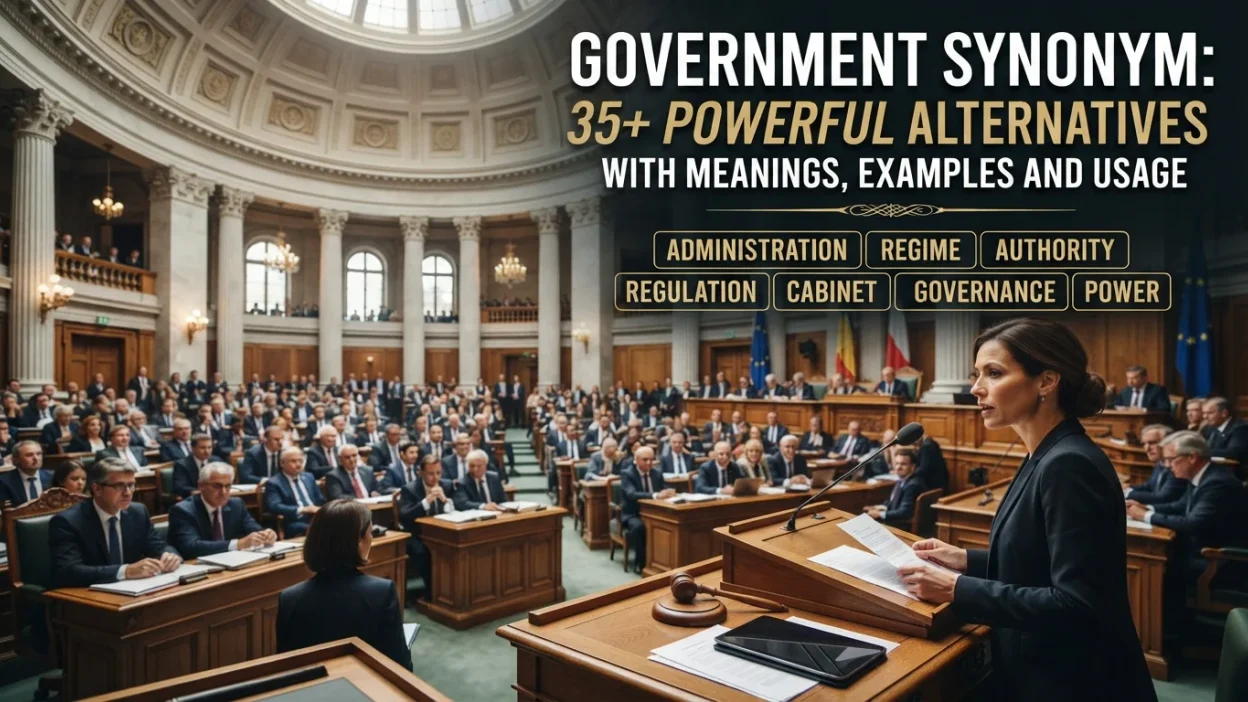
Government is one of the most important words in political, legal, and everyday language. It refers to the system or group of people that controls and manages a country or region. If you are searching for a government synonym, you have probably noticed that repeating the same word makes your writing feel repetitive and narrow. This complete guide will explain what government means, explore more than 35 alternatives with clear examples, and help you choose the perfect word for every context.
What Does Government Mean? 📖
Government refers to the group of people who have the authority to govern a country, state, or community. It also refers to the system or method by which a country is ruled, as well as the act of governing itself.
For example, “The government announced new tax reforms” refers to the group of leaders in power. “The country has a democratic government” refers to the system of rule. “Good government requires transparency” refers to the practice of governing.
The word can be used in several distinct ways. It can mean the ruling body, the political system, the administrative machinery, or the act of exercising authority. Understanding which meaning you need is the first step toward choosing the right synonym.
Connotation and Tone of Government 🎭
The tone of government is neutral and factual. It does not carry strong emotional weight on its own. It is a standard term used in news reports, academic writing, legal documents, and everyday conversation.
However, the word can take on positive or negative associations depending on the context and the speaker’s views. For some, government suggests order, protection, and public service. For others, it suggests bureaucracy, control, or inefficiency. The word itself remains neutral, but the surrounding language shapes how it is received.
In formal writing, government is precise and appropriate. In casual conversation, people often use shorter or more specific terms like the authorities, the administration, or simply the state. The right choice depends on your audience and the level of formality you need.
Origin and Etymology 📜
The word government comes from the Old French governement, meaning control, direction, or rule. This traces back to the Latin gubernare, meaning to steer, pilot, or direct a ship. The same Latin root gives us the word governor, which originally meant a steersman.
The word entered English in the fourteenth century. Originally, it referred to the act of governing or the exercise of authority. Over time, it came to refer to the body of people who exercise that authority, as well as the system they use.
The Latin root gubernare is also related to the Greek kybernan, meaning to steer. This connection gives the word a rich sense of guidance and direction, not just control.
Pronunciation 🗣️
- American English IPA: /ˈɡʌvərnmənt/
- British English IPA: /ˈɡʌvənmənt/
- Syllable Count: Three syllables (gov-ern-ment)
- Simple Pronunciation Guide: GUV-urn-munt
The primary stress falls on the first syllable, “gov.” In natural speech, many English speakers drop the “n” sound in the middle syllable, making it sound like “GUV-uh-munt.” Both pronunciations are widely accepted.
Word Formation and Grammar ✍️
Government is a noun. It can be countable or uncountable depending on the meaning. When it refers to a specific ruling body, it is countable: “The government has changed” or “Several governments have tried to solve the crisis.” When it refers to the system or act of governing, it is uncountable: “Government is necessary for a stable society.”
The adjective form is governmental, meaning related to government. The adverb form is governmentally, though this is rare. The verb form is govern, meaning to rule or control. The noun governor refers to a person who governs, especially a state official.
Related forms include self-government, meaning the rule of a country by its own people, and misgovernment, meaning poor or corrupt rule. The word is often used in compounds like government policy, government spending, and government agency.
35+ Synonyms and Their Meanings 📚
The following list provides a wide range of alternatives for government, each with its own shade of meaning, tone, and context. These alternatives will help you avoid repetition and choose the most precise word for your sentence.
1. Administration
Meaning: The group of people who manage the affairs of a government, especially a particular president or prime minister’s term.
Example: The new administration promised to reform the healthcare system.
Usage: Neutral and common. Often used in American English for the executive branch.
2. Regime
Meaning: A system or government, often one that is authoritarian or newly established.
Example: The military regime suppressed dissent and controlled the media.
Usage: Often negative or neutral. It frequently implies authoritarian rule.
3. Authority
Meaning: The power or right to give orders and make decisions, or the people who hold that power.
Example: The local authority approved the new housing development.
Usage: Neutral. Often used for local or regional government bodies.
4. Authorities
Meaning: The organizations or people with political or administrative power.
Example: The authorities launched an investigation into the accident.
Usage: Neutral and common in news reporting. Often used for police or local officials.
5. State
Meaning: A nation or territory considered as an organized political community under one government.
Example: The state provides healthcare and education to all citizens.
Usage: Formal and political. Often used in discussions of policy and sovereignty.
6. Nation
Meaning: A large body of people united by common descent, history, culture, or language, often with its own government.
Example: The nation celebrated its independence day with parades.
Usage: Neutral. It emphasizes the people and culture more than the ruling body.
7. Country
Meaning: A nation with its own government and territory.
Example: The country has a long history of democratic elections.
Usage: Neutral and informal. Often used in everyday speech.
8. Regime
Meaning: A government, especially an authoritarian one.
Example: The regime cracked down on political opponents.
Usage: Often negative. It implies strict or repressive rule.
9. Leadership
Meaning: The people who lead or guide a government, organization, or group.
Example: The country’s leadership changed after the election.
Usage: Neutral. Often used for the people at the top rather than the system.
10. Rulers
Meaning: The people who govern a country.
Example: The rulers of the ancient kingdom built great monuments.
Usage: Neutral to negative. Often used for monarchs or authoritarian leaders.
11. Sovereign
Meaning: A supreme ruler, especially a monarch; or a nation with its own government.
Example: The sovereign has limited power under the constitution.
Usage: Formal and legal. Often used for kings, queens, or independent states.
12. Sovereignty
Meaning: Supreme power or authority; the authority of a state to govern itself.
Example: The treaty recognized the sovereignty of the newly independent nation.
Usage: Formal and political. It refers to the principle rather than the body.
13. Governing Body
Meaning: The group of people who make decisions and set policy for an organization or state.
Example: The governing body of the university approved the new curriculum.
Usage: Neutral and formal. Often used for institutions rather than countries.
14. Political System
Meaning: The set of institutions, laws, and processes by which a country is governed.
Example: The country’s political system is based on a parliamentary democracy.
Usage: Academic and neutral. It emphasizes the system rather than the people.
15. Body Politic
Meaning: The people of a nation considered as a political community.
Example: The body politic demanded greater transparency from its leaders.
Usage: Formal and literary. It emphasizes the people rather than the rulers.
16. Civil Authority
Meaning: The non-military government of a region.
Example: Civil authority was restored after the conflict ended.
Usage: Formal and legal. Often used in contrast to military rule.
17. Public Sector
Meaning: The part of the economy controlled by the government.
Example: The public sector employs millions of people in healthcare and education.
Usage: Economic and neutral. It refers to government activity rather than the government itself.
18. Bureaucracy
Meaning: The system of officials and administrators who run a government or organization.
Example: The bureaucracy made it difficult to get a simple permit approved.
Usage: Often negative. It emphasizes inefficiency and red tape.
19. Apparatus
Meaning: The complex structure of an organization or system, especially a political one.
Example: The government apparatus was slow to respond to the crisis.
Usage: Formal and often critical. It suggests a large, impersonal system.
20. Machine
Meaning: The organization and structure of a political party or government.
Example: The political machine controlled every aspect of local government.
Usage: Often negative. It implies behind-the-scenes control.
21. Council
Meaning: A group of people elected or appointed to make decisions for a local government or organization.
Example: The city council voted to increase funding for public parks.
Usage: Neutral. Often used for local or municipal government.
22. Cabinet
Meaning: The group of senior ministers who advise a president or prime minister and lead government departments.
Example: The cabinet met to discuss the budget crisis.
Usage: Formal and political. It refers to the top leadership of a government.
23. Ministry
Meaning: A government department responsible for a specific area of public administration.
Example: The Ministry of Health launched a new vaccination campaign.
Usage: Formal. Common in parliamentary systems.
24. Directorate
Meaning: A board or group of directors who manage an organization or government department.
Example: The directorate oversees all environmental policy.
Usage: Formal and administrative. Often used in European contexts.
25. Junta
Meaning: A military or political group that rules a country after taking power by force.
Example: The junta seized control of the country in a coup.
Usage: Negative. Almost always used for authoritarian military rule.
26. Oligarchy
Meaning: A small group of people who hold power and control a country or organization.
Example: The oligarchy controlled the country’s wealth and politics.
Usage: Negative. It implies rule by a wealthy elite.
27. Plutocracy
Meaning: A government or society ruled by the wealthy.
Example: Critics argued that the country had become a plutocracy.
Usage: Negative. It implies that money controls politics.
28. Theocracy
Meaning: A system of government in which religious leaders rule in the name of God.
Example: The theocracy enforced strict religious laws.
Usage: Political and often critical. It refers to religious rule.
29. Monarchy
Meaning: A form of government with a king or queen at the head.
Example: The monarchy has survived for centuries despite political changes.
Usage: Neutral and historical. It refers to rule by a single hereditary sovereign.
30. Democracy
Meaning: A system of government in which power is held by the people, usually through elected representatives.
Example: The country transitioned to democracy after decades of dictatorship.
Usage: Positive and political. It is a specific form of government.
31. Republic
Meaning: A form of government in which the country is considered a public matter, with leaders elected by the people.
Example: The republic was founded on the principles of liberty and equality.
Usage: Neutral and political. It is a specific form of government.
32. Federation
Meaning: A group of states or organizations united by a central government.
Example: The federation allows each state to make its own laws.
Usage: Formal and political. It refers to a specific structure.
33. Commonwealth
Meaning: A political community founded for the common good, or a group of countries with shared interests.
Example: The commonwealth provides aid to its member states.
Usage: Formal and political. It is often used for specific international associations.
34. The Powers That Be
Meaning: The people who have authority and control in a situation.
Example: The powers that be decided to close the factory.
Usage: Informal and often critical. It suggests an unknown or unaccountable authority.
35. City Hall
Meaning: The local government of a city, or the building where it meets.
Example: City Hall announced a new plan to improve public transport.
Usage: Informal and local. Often used in American English.
36. Whitehall
Meaning: The British government or civil service, named after the street in London where many government offices are located.
Example: Whitehall is preparing new regulations for the tech industry.
Usage: Informal and British. Often used in journalism.
37. Washington
Meaning: The U.S. federal government, named after the capital city.
Example: Washington has not yet responded to the trade dispute.
Usage: Informal and American. Common in political journalism.
38. Westminster
Meaning: The British Parliament and government, named after the area of London where Parliament sits.
Example: Westminster is debating the new immigration bill.
Usage: Informal and British. Common in political journalism.
Synonym Comparison Table 📊
| Synonym | Meaning | Tone or Context | Example |
|---|---|---|---|
| Administration | The group managing government affairs | Neutral, American | The new administration promised reform. |
| Regime | A system of government, often authoritarian | Often Negative | The military regime suppressed dissent. |
| Authority | The power to make decisions, or the body holding it | Neutral, Local | The local authority approved the plan. |
| Authorities | Organizations with administrative power | Neutral, News | The authorities launched an investigation. |
| State | An organized political community | Formal, Political | The state provides healthcare. |
| Nation | People united by culture or history | Neutral, Cultural | The nation celebrated independence. |
| Country | A nation with its own government | Informal, Common | The country held free elections. |
| Leadership | The people who lead a government | Neutral | The country’s leadership changed. |
| Rulers | The people who govern a country | Neutral to Negative | The rulers built great monuments. |
| Governing Body | The group making decisions | Formal, Institutional | The governing body approved the plan. |
| Bureaucracy | The system of government officials | Often Negative | The bureaucracy slowed the process. |
| Council | A local decision-making body | Neutral, Local | The city council voted on the budget. |
| Cabinet | Senior ministers advising a leader | Formal, Political | The cabinet met to discuss the crisis. |
| Junta | A military group ruling by force | Negative | The junta seized power in a coup. |
| Democracy | Government by the people | Positive, Political | The country transitioned to democracy. |
| The Powers That Be | Those with authority | Informal, Critical | The powers that be closed the factory. |
How to Choose the Right Synonym 🎯
Choosing the right synonym for government depends on what aspect you want to emphasize. If you are referring to the ruling body in a neutral, standard way, administration or authorities works well. These words are common in news and everyday writing.
If you are writing about the political system as a whole, state, political system, or nation are strong choices. These words carry a sense of sovereignty and structure.
If you want to criticize the government for being authoritarian or inefficient, regime, bureaucracy, or junta are powerful options. These words carry negative connotations and should be used carefully.
If you are writing about a specific type of government, such as a democracy, monarchy, or republic, it is often better to name it directly. This adds precision and avoids ambiguity.
If you are writing informally or journalistically, Washington, Westminster, or city hall can add color and immediacy. These metonyms are common in political reporting.
Always consider your audience. Formal academic writing calls for state, political system, or governing body. Casual conversation might call for the authorities or city hall. Match your vocabulary to your reader.
Related Words and Word Forms 🔗
Several related words and forms capture different aspects of government. The verb govern means to rule or control. The noun governor refers to a person who governs, especially a state official. The adjective governmental means related to government.
Other related words include governance, which refers to the act or process of governing, often with an emphasis on accountability and effectiveness. Sovereignty refers to supreme authority. Politics refers to the activities associated with governing. Policy refers to the decisions and plans made by a government.
The word government is also used in compounds like self-government, local government, and government spending. Each of these adds a specific shade of meaning.
Antonyms of Government 🔄
Understanding the opposites of government can help clarify its meaning. These words describe the absence of government or the rejection of its authority.
- Anarchy: A state of disorder due to absence or non-recognition of authority. Example: The collapse of the government led to anarchy.
- Chaos: Complete disorder and confusion. Example: Without government, the region descended into chaos.
- Lawlessness: The state of being without laws or ignoring them. Example: Lawlessness spread after the police withdrew.
- Rebellion: Open resistance to an established government. Example: The rebellion was crushed by government forces.
- Revolution: A forcible overthrow of a government. Example: The revolution ended centuries of monarchy.
- Dissent: Disagreement with or opposition to the government. Example: Dissent was suppressed by the regime.
- Libertarianism: A political philosophy that advocates minimal government. Example: Libertarianism argues for less government interference.
Some of these are direct opposites, while others are contextual. For example, anarchy is a direct opposite of government. Dissent is an opposite only in the sense of opposing a particular government, not government itself.
Common Mistakes to Avoid ⚠️
One common mistake is using government and administration as exact synonyms. In American English, administration often refers specifically to the executive branch under a particular president. Government is broader and includes all branches and levels.
Another mistake is using regime neutrally. Regime often carries a negative connotation, implying authoritarian or illegitimate rule. If you want to stay neutral, use government or administration instead.
A third mistake is confusing government with state. The state is a broader concept that includes the territory, the people, and the institutions. Government is the group that exercises authority within the state. The two are related but not identical.
Finally, avoid using informal metonyms like Washington or Westminster in formal writing unless the context makes them clear. These words are excellent in journalism but may confuse readers unfamiliar with the reference.
Frequently Asked Questions ❓
What does government mean?
Government refers to the group of people who have the authority to govern a country or region, as well as the system by which a country is ruled and the act of governing itself.
What is the closest synonym to government?
Administration is the closest synonym for the ruling body, especially in American English. State is the closest synonym for the broader political entity. Authorities is close for local or administrative bodies.
What is a formal alternative to government?
State, political system, and governing body are excellent formal alternatives. These words are common in academic, legal, and political writing.
What is an informal alternative to government?
The authorities, city hall, Washington, and Westminster are informal alternatives. These words are common in news reporting and casual conversation.
What is the opposite of government?
The opposite of government is anarchy, chaos, or lawlessness. These words describe the absence of authority and order.
Can government be used in academic writing?
Yes, government is perfectly acceptable in academic writing. For more precise language, state, political system, or governance may be better choices depending on the context.
How does government differ from state?
Government refers to the group of people who exercise authority at a given time. State refers to the broader political entity, including its territory, people, and institutions. Governments change; the state endures.
Which synonym works best in everyday conversation?
The authorities and the government are the most natural choices in everyday conversation. City hall works well for local government, and Washington or Westminster work well in political discussions.
Conclusion
Finding the perfect government synonym is about understanding which aspect of rule and authority you want to emphasize. Whether you choose administration for the ruling body, state for the political entity, or authorities for local officials, the right word can make your writing more precise and engaging.
Remember that the best synonym always depends on context, tone, and audience. Some words are neutral and formal, while others are critical or informal. Use this guide to choose your words with care, and your writing will govern the page with confidence.

Emily Carter is a passionate writer who enjoys creating engaging, informative and easy-to-read content for a wide audience. She focuses on delivering helpful insights and fresh ideas that inform, inspire and connect with readers.