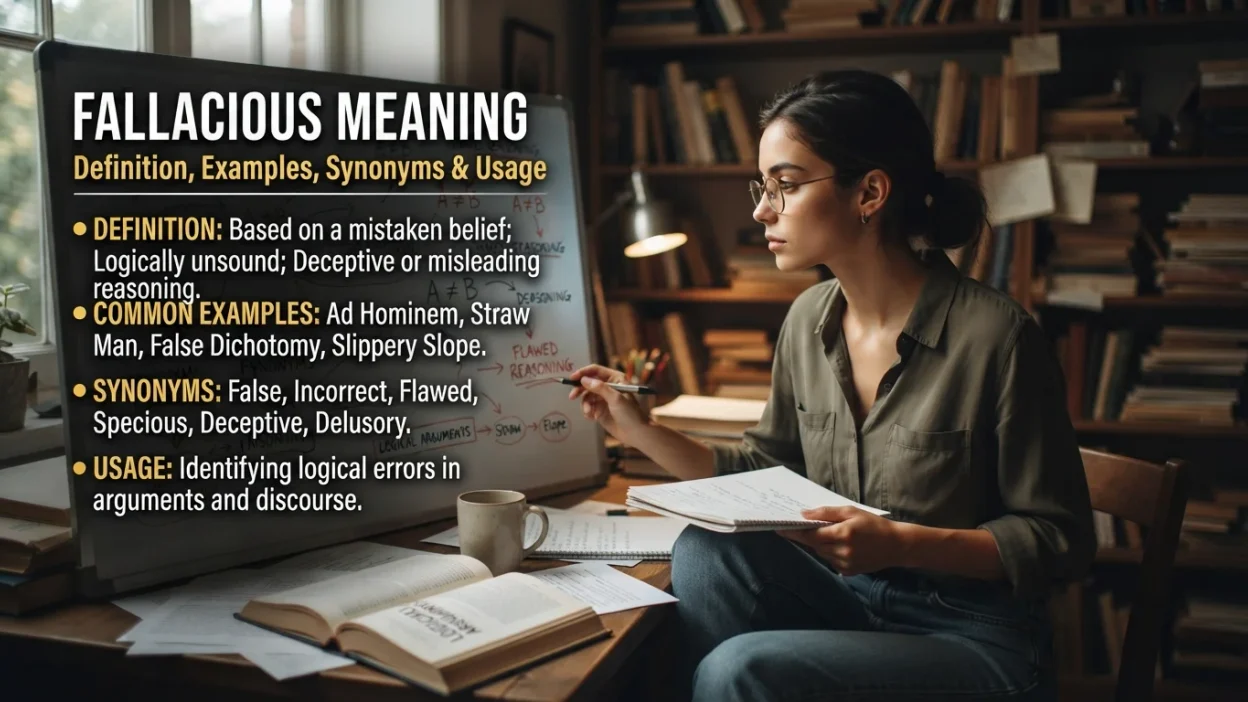
Have you ever heard an argument that sounds convincing but does not make sense when you examine it closely? The word fallacious describes something based on false reasoning, incorrect information, or a mistaken belief. Understanding the fallacious meaning can help you recognize misleading arguments, improve critical thinking, and communicate more clearly.
In simple terms, fallacious means false or misleading because of faulty reasoning. A fallacious argument may sound logical at first, but its conclusion does not follow from the evidence provided.
What Does Fallacious Mean?
The adjective fallacious means containing an error in reasoning or creating a false impression. People often use this word when discussing arguments, claims, assumptions, and conclusions that appear reasonable but are not supported by sound logic.
Example: “His conclusion was based on a fallacious argument.”
This sentence means that his argument contained faulty reasoning, so the conclusion was not reliable.
Fallacious does not always mean that someone is deliberately lying. A person may make a fallacious argument because they misunderstand the facts, overlook important evidence, or use an incorrect assumption.
Fallacious Meaning in Simple Words
In everyday English, fallacious means wrong or misleading because the reasoning behind it is flawed.
For example, imagine someone says, “My friend became successful after wearing a lucky bracelet, so the bracelet causes success.” This conclusion is fallacious because one event does not prove that the bracelet caused the success.
Here are a few simple examples:
- A fallacious argument: A claim supported by faulty logic.
- A fallacious assumption: A belief based on incorrect reasoning.
- A fallacious conclusion: A conclusion that does not logically follow from the available evidence.
- Fallacious information: Information presented in a way that creates a mistaken impression.
Fallacious Pronunciation
Fallacious is pronounced fuh-LAY-shus.
- Part of speech: Adjective
- Syllables: Three
- Word form: Fallaciously is the adverb, and fallaciousness is the noun.
- Common use: Formal writing, academic discussions, debates, and critical analysis.
Examples of Fallacious in Sentences
Seeing the word in context makes its meaning easier to understand. The following sentences show how fallacious can be used in everyday and formal situations.
- The student presented a fallacious argument during the classroom debate.
- Her conclusion was fallacious because it relied on incomplete evidence.
- The advertisement used fallacious reasoning to persuade customers.
- Assuming that every expensive product is better is a fallacious belief.
- The researcher identified a fallacious claim in the report.
- His explanation sounded convincing, but its logic was fallacious.
- We should question fallacious assumptions before making important decisions.
- The politician was criticized for using fallacious arguments.
- The article challenged a fallacious idea that had spread online.
- A fallacious comparison can lead readers to misunderstand the facts.
What Is a Fallacious Argument?
A fallacious argument is an argument that contains a logical error. It may have an appealing conclusion, confident language, or apparently convincing evidence, but the reasoning does not adequately support the conclusion.
For example:
“Everyone in my class likes this movie, so it must be the best movie ever made.”
This argument is fallacious because the preferences of one group do not establish that a movie is objectively the best.
Fallacious arguments commonly appear in debates, advertisements, social media posts, political discussions, and everyday conversations. Recognizing them helps people evaluate claims more carefully instead of accepting them simply because they sound persuasive.
Common Types of Fallacious Reasoning
Several common logical fallacies can make an argument fallacious.
1. Ad Hominem
An ad hominem argument attacks a person instead of addressing the person’s reasoning or evidence.
Example: “Your opinion about education is wrong because you are young.”
The person’s age does not, by itself, establish whether the opinion is correct.
2. False Dilemma
A false dilemma presents only two choices when other reasonable possibilities exist.
Example: “You either agree with my plan or you do not care about the company.”
Someone might disagree with the plan while still caring about the company.
3. Hasty Generalization
A hasty generalization draws a broad conclusion from too little evidence.
Example: “Two people from that town were rude, so everyone there must be rude.”
Two experiences cannot justify a conclusion about an entire population.
4. Appeal to Popularity
This fallacy treats a belief as true simply because many people accept it.
Example: “Millions of people believe this claim, so it must be true.”
Popularity does not automatically prove accuracy.
5. Post Hoc Reasoning
This error assumes that because one event happened before another, the first event caused the second.
Example: “I wore my favorite shirt before getting a promotion, so the shirt caused my promotion.”
The sequence of events alone does not establish causation.
Fallacious vs. False: What Is the Difference?
The words fallacious and false are related, but they have different meanings.
| Word | Meaning | Example |
|---|---|---|
| Fallacious | Based on faulty reasoning or likely to mislead | The argument was fallacious because it relied on a weak assumption. |
| False | Not true or factually incorrect | The statement that Earth is flat is false. |
| Misleading | Likely to give someone the wrong impression | The advertisement used misleading wording. |
| Incorrect | Not accurate or right | The answer was incorrect. |
A statement can be false without involving a logical fallacy. Similarly, an argument can use fallacious reasoning even if its conclusion happens to be true. The key distinction is between the truth of a claim and the quality of the reasoning used to support it.
Fallacious Synonyms
Synonyms are words with similar meanings. The best synonym for fallacious depends on the sentence and the kind of error being described.
- Faulty: Containing an error or defect.
- Flawed: Having a weakness or problem.
- Erroneous: Incorrect or based on an error.
- Misleading: Giving the wrong impression.
- Unsound: Not supported by good reasoning or evidence.
- Deceptive: Likely to make someone believe something untrue, sometimes intentionally.
- Invalid: Not logically or factually acceptable in a particular context.
- Specious: Appearing correct or convincing while actually being misleading.
- Unfounded: Not supported by sufficient evidence.
- Illogical: Not following sound reasoning.
For arguments, faulty, unsound, and illogical are often useful alternatives. For claims that seem convincing but are misleading, specious may be especially appropriate.
Fallacious Antonyms
Antonyms are words with opposite or contrasting meanings.
- Logical: Based on sound reasoning.
- Valid: Reasonable or logically well-founded in context.
- Sound: Supported by reliable reasoning and appropriate evidence.
- Accurate: Correct and free from factual errors.
- Reasonable: Based on sensible judgment.
- Well-founded: Supported by good evidence or justification.
- Reliable: Dependable and trustworthy.
For example, “a fallacious argument” contrasts with “a sound argument” because the latter is supported by appropriate reasoning.
How to Use Fallacious in Everyday Writing
Fallacious is a formal word, so it is particularly useful in essays, reports, debates, research, and analytical writing.
Use it when you want to explain that an argument or assumption is flawed rather than merely disagreeing with it.
Examples:
- Academic writing: “The study challenges the fallacious assumption that correlation always proves causation.”
- Workplace communication: “We should review this fallacious conclusion before making a business decision.”
- Online discussions: “That claim is fallacious because the evidence does not support it.”
- Critical analysis: “The author identifies several fallacious arguments in the opposing position.”
When speaking casually, you can often use simpler expressions such as “bad reasoning,” “flawed logic,” or “a misleading argument.”
Why Is Recognizing Fallacious Reasoning Important?
Recognizing fallacious reasoning helps you make better decisions and evaluate information more carefully. People encounter persuasive claims every day, including product advertisements, news commentary, political speeches, and social media posts.
Understanding logical fallacies can help you:
- Separate evidence from assumptions.
- Identify weak arguments during discussions.
- Avoid accepting claims simply because they are popular.
- Make more balanced decisions.
- Explain disagreements without attacking other people.
- Evaluate whether a conclusion follows from the available evidence.
The goal is not to label every disagreement as fallacious. Instead, examine the reasoning, ask what evidence supports the claim, and consider whether alternative explanations exist.
Frequently Asked Questions About Fallacious Meaning
1. What does fallacious mean in simple terms?
Fallacious means based on faulty reasoning or likely to mislead. A fallacious argument may sound convincing but does not logically support its conclusion.
2. Is fallacious a negative word?
Yes, it generally has a negative meaning because it describes flawed reasoning, an incorrect assumption, or a misleading argument.
3. Does fallacious mean false?
Not exactly. False means untrue, while fallacious usually describes faulty reasoning. A fallacious argument can reach a true conclusion by using poor logic.
4. What is an example of a fallacious argument?
“Everyone buys this product, so it must be the best.” This is fallacious because popularity alone does not prove that a product is the best.
5. What is the difference between fallacious and erroneous?
Fallacious usually emphasizes faulty reasoning or misleading logic. Erroneous more broadly means incorrect or mistaken.
6. What is the noun form of fallacious?
The noun form is fallaciousness, meaning the quality of being fallacious. The word fallacy refers to an error in reasoning or a mistaken belief.
7. What is the opposite of fallacious?
Depending on the context, opposites include logical, sound, valid, accurate, and well-founded.
8. Can a fallacious argument have a correct conclusion?
Yes. A conclusion may happen to be correct even when the reasoning used to reach it is faulty. A reliable argument needs appropriate reasoning and supporting evidence, not merely a correct conclusion.
Conclusion
The word fallacious describes reasoning, arguments, or assumptions that are flawed or misleading. It is commonly used when discussing logic, debates, research, and everyday claims.
Remember that fallacious does not necessarily mean deliberately dishonest; it means that the reasoning behind an argument is unreliable. By examining evidence and questioning assumptions, you can recognize fallacious claims and make better-informed decisions.

Emily Carter is a passionate writer who enjoys creating engaging, informative and easy-to-read content for a wide audience. She focuses on delivering helpful insights and fresh ideas that inform, inspire and connect with readers.