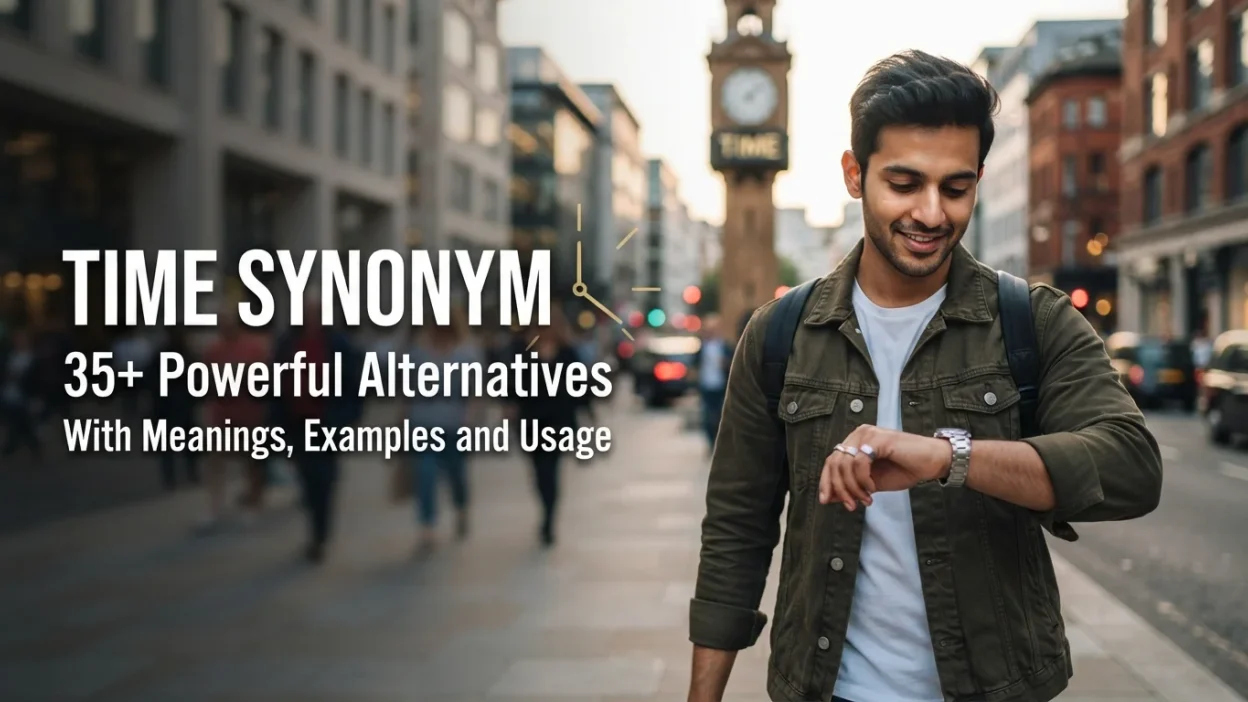
Time is one of the most fundamental words in English. We use it to talk about seconds, hours, eras, and opportunities. If you are searching for a time synonym, you have probably noticed that the right alternative depends entirely on which sense of the word you intend. This complete guide will explain what time means, explore more than 35 alternatives with clear examples, and help you choose the perfect word for every context.
What Does Time Mean? 📖
Time is a broad noun with several distinct meanings. And it can refer to an opportunity or suitable moment, such as “the right time to act.”
The word also functions as a verb meaning to measure or schedule something, as in “time the race” or “time your arrival.”
Because time covers so many meanings, choosing the right synonym requires understanding which sense you intend. This guide groups alternatives by their specific sense: duration, moment, era, opportunity, and rhythm.
Connotation and Tone of Time 🎭
The tone of time is neutral and practical. It carries no strong emotional weight on its own. It is a standard word used in science, philosophy, business, and everyday conversation.
However, time can take on emotional weight in certain contexts. Phrases like “time is running out” or “the time of our lives” carry urgency or joy. In philosophical writing, time can feel abstract and profound.
In everyday conversation, time is casual and natural. People talk about time in terms of schedules, deadlines, and memories. The word itself is neither formal nor informal; it fits comfortably in almost any setting.
Unlike words like era or epoch, which refer to long historical periods, time is flexible and can refer to anything from a split second to an eternity.
Origin and Etymology 📜
The word time comes from the Old English tīma, meaning time, season, or hour. It is related to the Old Norse tími and the German Zeit, all meaning time.
The word has been used in English for over a thousand years. Originally, it referred to a limited or appointed period. Over time, the meaning expanded to include the general concept of time as a continuous progression.
The root is also found in words like tide, which originally meant a period or season before taking on its modern meaning related to the sea. This connection reminds us that time was once understood in terms of natural cycles and seasons.
Pronunciation 🗣️
- American English IPA: /taɪm/
- British English IPA: /taɪm/
- Syllable Count: One syllable (time)
- Simple Pronunciation Guide: tyme
The word rhymes with “lime” and “climb.” The final “e” is silent. Both American and British English pronounce the word identically.
Word Formation and Grammar ✍️
Time is primarily a noun, but it can also function as a verb. As a noun, it can be countable or uncountable depending on the meaning. When it refers to a specific occasion, it is countable: “We had a great time.” When it refers to the general concept, it is uncountable: “Time is precious.”
As a verb, time means to measure, schedule, or arrange the timing of something. For example, “She timed the race” or “He timed his entrance perfectly.”
The adjective form is timely, meaning occurring at the right moment. The adverb form timely is rare. The noun timing refers to the ability to choose the right moment.
Common phrases include on time, in time, at times, for the time being, and time after time. These phrases are widely used and understood.
35+ Synonyms and Their Meanings 📚
The following list provides a wide range of alternatives for time, grouped by the sense in which you might use the word.
Duration and Period Alternatives
1. Duration
Meaning: The length of time something continues or lasts.
Example: The duration of the flight was six hours.
Usage: Formal and precise. Often used for specific, measured periods.
2. Period
Meaning: A length or portion of time.
Example: The project was completed over a three-month period.
Usage: Neutral and common. Very versatile.
3. Span
Meaning: The full extent or duration of something.
Example: The span of his career covered four decades.
Usage: Neutral and slightly formal. Often used for careers, lives, and attention.
4. Interval
Meaning: A period of time between two events.
Example: There was a short interval between the two performances.
Usage: Formal. Often used for breaks and scheduled gaps.
5. Stretch
Meaning: A continuous period of time.
Example: She worked for a long stretch without a break.
Usage: Informal. Often used for work and effort.
6. While
Meaning: A period of time.
Example: We waited for a while before the bus arrived.
Usage: Neutral and common. Often used in phrases like “a while ago.”
7. Spell
Meaning: A short period of time, often used for weather.
Example: After a spell of rain, the sun finally appeared.
Usage: Neutral. Often used for weather and activity.
8. Term
Meaning: A fixed period of time, especially in office or education.
Example: The president served a four-year term.
Usage: Formal. Often used for official positions and school periods.
Moment and Occasion Alternatives
9. Moment
Meaning: A very brief period of time; a specific point in time.
Example: The moment she entered the room, everyone applauded.
Usage: Neutral and common. Emphasizes brevity or significance.
10. Instant
Meaning: An extremely short period of time; a precise moment.
Example: The instant the lights went out, the crowd gasped.
Usage: Neutral. Emphasizes immediacy.
11. Occasion
Meaning: A particular event or moment.
Example: The wedding was a joyful occasion.
Usage: Formal and neutral. Often used for special events.
12. Point
Meaning: A specific moment in time.
Example: At that point, we decided to leave.
Usage: Neutral and common. Often used in narrative.
13. Juncture
Meaning: A particular point in time, especially one requiring decision.
Example: At this critical juncture, leadership is essential.
Usage: Formal and literary. Often used for critical moments.
14. Instant
Meaning: A precise moment in time.
Example: The instant the news broke, the phones began ringing.
Usage: Neutral. Emphasizes immediacy.
Era and Age Alternatives
15. Era
Meaning: A long and distinct period of history.
Example: The Victorian era was marked by industrial growth.
Usage: Formal and historical.
16. Age
Meaning: A distinct period of history or a person’s lifespan.
Example: The Stone Age lasted for thousands of years.
Usage: Neutral. Often used for historical and geological periods.
17. Epoch
Meaning: A particular period of time in history or a person’s life.
Example: The invention of the internet marked a new epoch in communication.
Usage: Formal and literary. Often used for major historical shifts.
18. Generation
Meaning: All the people born and living at about the same time.
Example: The younger generation has different priorities.
Usage: Neutral. Often used in social and cultural contexts.
19. Century
Meaning: A period of one hundred years.
Example: The building has stood for over a century.
Usage: Neutral. Specifically a hundred-year period.
20. Decade
Meaning: A period of ten years.
Example: The company grew rapidly over the past decade.
Usage: Neutral. Specifically a ten-year period.
Opportunity and Suitable Moment Alternatives
21. Opportunity
Meaning: A set of circumstances that makes it possible to do something.
Example: This is a great opportunity to learn a new skill.
Usage: Neutral and positive. Emphasizes possibility.
22. Chance
Meaning: An opportunity to do or achieve something.
Example: She took a chance and started her own business.
Usage: Neutral. Often implies risk or luck.
23. Opening
Meaning: An opportunity or chance, especially in a competitive situation.
Example: The job opening attracted hundreds of applicants.
Usage: Neutral. Often used in professional contexts.
24. Window
Meaning: A period of time during which an opportunity exists.
Example: There is a narrow window to apply for the grant.
Usage: Informal to formal. Emphasizes limited opportunity.
25. Turn
Meaning: An opportunity or obligation to do something in sequence.
Example: It is your turn to speak.
Usage: Neutral and common.
Rhythm and Tempo Alternatives
26. Tempo
Meaning: The speed at which something happens or is done.
Example: The tempo of the music increased gradually.
Usage: Neutral. Often used in music and activity.
27. Pace
Meaning: The speed at which something happens or develops.
Example: The pace of technological change is accelerating.
Usage: Neutral and common.
28. Rhythm
Meaning: A regular pattern of movement or sound.
Example: The rhythm of the waves was soothing.
Usage: Neutral and slightly literary.
29. Rate
Meaning: A measure, quantity, or frequency, typically one measured against another quantity or measure.
Example: The rate of progress was slower than expected.
Usage: Neutral and technical.
30. Speed
Meaning: The rate at which something moves or operates.
Example: The speed of the train was impressive.
Usage: Neutral and common.
31. Beat
Meaning: A rhythmic unit of time in music.
Example: The song has a catchy beat.
Usage: Neutral. Often used in music.
32. Cadence
Meaning: A rhythmic flow of sounds or words.
Example: The cadence of her speech was mesmerizing.
Usage: Formal and literary.
Other Temporal Alternatives
33. Timeline
Meaning: A schedule or plan that shows when events are expected to happen.
Example: The timeline for the project spans six months.
Usage: Formal and project-focused.
34. Schedule
Meaning: A plan for carrying out a process or procedure.
Example: The construction schedule was delayed by rain.
Usage: Neutral and common.
35. Calendar
Meaning: A system for organizing days, weeks, and months.
Example: The academic calendar lists all the important dates.
Usage: Neutral. Specifically refers to the system of organizing time.
36. Season
Meaning: A period of the year characterized by particular conditions or activities.
Example: The holiday season is a busy time for retailers.
Usage: Neutral. Often used for weather or holidays.
37. Tide
Meaning: A period or season (archaic), or the rise and fall of the sea.
Example: Time and tide wait for no man.
Usage: Archaic and literary. Rare in modern usage except in idioms.
Synonym Comparison Table 📊
| Synonym | Meaning | Tone or Context | Example |
|---|---|---|---|
| Duration | Length of time something lasts | Formal, Precise | The duration of the flight was six hours. |
| Period | Length or portion of time | Neutral, Common | Over a three-month period. |
| Span | Full extent or duration | Neutral, Slightly Formal | The span of his career. |
| Interval | Time between two events | Formal | A short interval between performances. |
| Stretch | Continuous period of time | Informal | A long stretch without a break. |
| While | Period of time | Neutral, Common | We waited for a while. |
| Moment | Very brief period | Neutral, Common | The moment she entered, everyone applauded. |
| Instant | Extremely short period | Neutral | The instant the lights went out. |
| Occasion | Particular event or moment | Formal | A joyful occasion. |
| Juncture | Critical point in time | Formal, Literary | At this critical juncture. |
| Era | Long historical period | Formal, Historical | The Victorian era. |
| Epoch | Distinct period in history | Formal, Literary | A new epoch in communication. |
| Opportunity | Set of circumstances for action | Neutral, Positive | A great opportunity to learn. |
| Window | Period of limited opportunity | Informal to Formal | A narrow window to apply. |
| Tempo | Speed of activity | Neutral | The tempo of the music increased. |
| Pace | Speed of development | Neutral, Common | The pace of change is accelerating. |
How to Choose the Right Synonym 🎯
Choosing the right synonym for time depends entirely on which sense you intend. If you are talking about duration, period, duration, and span are precise and natural. These words work well in both formal and informal contexts.
If you are referring to a specific moment, moment, instant, and point are clear and widely understood. Occasion and juncture work better for significant or critical moments.
If you are describing a long historical period, era, age, and epoch are strong choices. These words are common in history and literature.
If you are talking about opportunity, opportunity, chance, and window are the most appropriate. These words are common in professional and personal contexts.
If you are referring to rhythm or speed, tempo, pace, and rate are precise and technical. These words are common in music, sports, and business.
Always consider your audience. Period and moment are universally understood. Epoch and juncture are formal and literary. Chance and stretch are informal and warm. Match your vocabulary to your reader.
Related Words and Word Forms 🔗
Several related words and forms capture different aspects of time. The adjective timely means occurring at the right moment. The noun timing refers to the ability to choose the right moment. The verb time means to measure or schedule.
Other related words include temporary, meaning lasting for a limited time, and timeless, meaning not affected by the passage of time. Timeline refers to a schedule of events. Timestamp refers to a digital record of when something occurred.
The phrase time management refers to the ability to use time effectively. Time zone refers to a region with the same standard time.
Antonyms of Time 🔄
Understanding the opposites of time is difficult because time is a fundamental concept. However, some contextual opposites include:
- Timelessness: The state of being eternal or unaffected by time. Example: The art has a sense of timelessness.
- Eternity: Infinite or unending time. Example: The stars seemed to stretch into eternity.
- Infinity: Endless time or space. Example: The concept of infinity is hard to grasp.
- Permanence: The state of lasting forever. Example: The monument was built for permanence.
These are not direct antonyms but rather contrasting concepts. Time implies change and limitation; these words imply the absence of those qualities.
Common Mistakes to Avoid ⚠️
One common mistake is treating time and period as exact synonyms in every context. Time is broader and can refer to the general concept, while period refers to a specific length of time. “Time is precious” is correct, but “period is precious” sounds strange.
Another mistake is confusing moment and instant. A moment can be slightly longer and more significant. An instant is extremely brief. “The moment we met” sounds romantic; “the instant we met” sounds more abrupt.
A third mistake is using era or epoch for short periods. These words refer to long historical periods. A meeting or a project is not an era.
Finally, avoid using informal words like stretch or while in formal writing. These words are excellent in conversation but may sound out of place in a professional report or academic paper.
Frequently Asked Questions ❓
What does time mean?
Time refers to the continuous progression of existence, a specific moment or occasion, a period or duration, or an opportunity or suitable moment. It can also function as a verb meaning to measure or schedule.
What is the closest synonym to time?
Period is the closest synonym for the duration sense. Moment is the closest synonym for the specific point sense. Opportunity is the closest synonym for the chance sense.
What is a formal alternative to time?
Duration, interval, juncture, and epoch are formal alternatives. These words are common in academic and technical writing.
What is an informal alternative to time?
Stretch, while, and chance are informal alternatives. These words are natural in conversation and casual writing.
What is the opposite of time?
The opposite of time is timelessness, eternity, or permanence. These words describe the absence of time or change.
Can time be used in academic writing?
Yes, time is perfectly acceptable in academic writing. For more precise language, duration, period, or interval may be better choices depending on the context.
How does time differ from era?
Time is a broad term that can refer to any period or moment. Era specifically refers to a long, distinct period of history. A conversation happens in time, but not in an era.
Which synonym works best in everyday conversation?
Moment, period, and chance are the most natural choices in everyday conversation. While and stretch are also common in casual speech.
Conclusion
Finding the perfect time synonym is about understanding which sense of the word you intend. Whether you choose period for duration, moment for a specific instant, or opportunity for a chance, the right word can make your meaning clearer and your writing more precise.
Remember that the best synonym always depends on context, tone, and audience. Some words are formal and technical, while others are casual and warm. Use this guide to choose your words with care, and your writing will stand the test of time.

Emily Carter is a passionate writer who enjoys creating engaging, informative and easy-to-read content for a wide audience. She focuses on delivering helpful insights and fresh ideas that inform, inspire and connect with readers.