
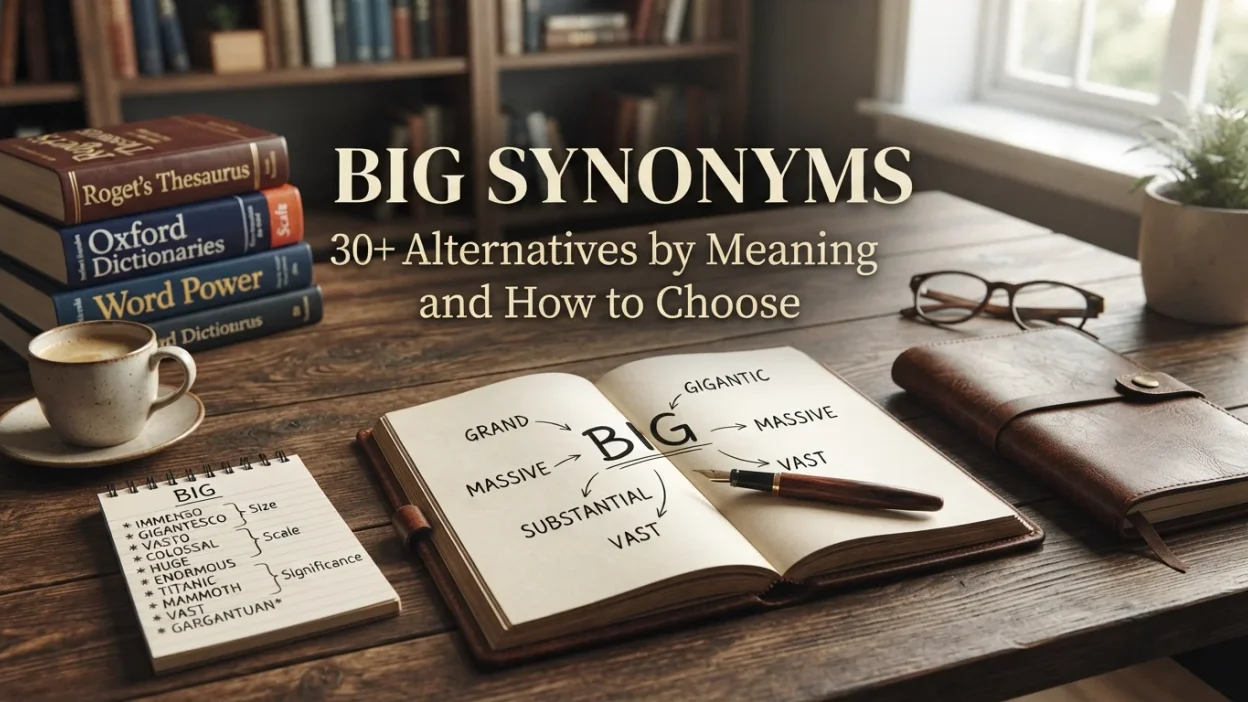
Big is one of the first adjectives English speakers learn and one of the last they stop overusing. We use it for objects, ideas, problems, opportunities, and personalities. That range makes big convenient, but it also makes it vague.
If you are looking for a big synonym, the right choice depends on whether you mean physical size, importance, intensity, or generosity. This guide explains what big means, offers 30+ accurate alternatives organized by sense, and shows you how to pick the one that fits.
What Does “Big” Mean? 📖
Big is an adjective that primarily describes something large in size, amount, or extent. It also describes something important or significant, a person who is older or more mature, or a gesture that is generous.
The word covers several distinct senses. The first is physical size: a big house, a big dog. The second is importance: a big decision, a big opportunity. The third is intensity: a big effort, a big change. The fourth is age: a big brother or big sister. The fifth is generosity: a big heart, a big gesture.
Connotation and Tone 🎭
Big is neutral in register and tone. It does not carry the formality of substantial or the informality of whopping. It is appropriate in almost every context, from casual conversation to professional writing.
That neutrality is useful, but it can make the word feel flat. When every size, problem, and opportunity is described as big, the word stops signaling scale. A more specific synonym communicates physical size, importance, or intensity far more precisely.
Applied to people, big can carry different tones. “A big personality” is usually positive, suggesting charisma. “A big ego” is negative, suggesting arrogance.
Origin and Etymology 📜
Big comes from Middle English big, meaning “strong” or “powerful.” It is likely of Scandinavian origin, related to the Old Norse byggja, meaning “to build” or “to dwell.” The original sense was closer to “strong” or “stout” than to “large.”
Over time, the meaning shifted from strength to size, and then extended to importance and significance. The word has been in continuous use since the 14th century and has become one of the most common adjectives in English.
Pronunciation 🗣️
- American English IPA: /bɪɡ/
- British English IPA: /bɪɡ/
- Syllable Count: One syllable
- Simple Pronunciation Guide: big (rhymes with dig and fig)
The vowel is short and crisp. The final *g* is voiced.
Word Formation and Grammar ✍️
Big is a gradable adjective, meaning it can be intensified: “very big,” “really big,” “pretty big.” It has comparative and superlative forms: bigger and biggest (note the doubled consonant).
The noun form bigness exists but is rare and awkward; writers usually rephrase with size or scale. The adjective bigger can function as a noun in informal contexts (“the bigger of the two”). The phrase big up is informal British slang meaning to praise or promote someone.
Common compounds include big-hearted, big-time, big-name, and big-headed.
30+ Synonyms and Their Meanings 📚
The following alternatives are grouped by the kind of bigness they describe. Choose based on whether you mean physical size, importance, intensity, or generosity.
Synonyms for Physical Size
1. Large
Meaning: Of considerable or relatively great size.
Example: They live in a large house on the edge of town.
Usage: The most direct and neutral synonym. Slightly more formal than big.
2. Huge
Meaning: Extremely large.
Example: A huge crowd gathered in the square.
Usage: Stronger than big. Common in speech and writing.
3. Enormous
Meaning: Very large in size, quantity, or extent.
Example: The project required an enormous amount of funding.
Usage: Formal and emphatic. Suggests something beyond normal scale.
4. Giant
Meaning: Much larger than usual.
Example: A giant crane lifted the steel beams into place.
Usage: Often used before nouns. Suggests dramatic scale.
5. Massive
Meaning: Very large, heavy, and solid.
Example: The castle was protected by massive stone walls.
Usage: Emphasizes weight and solidity as well as size.
6. Immense
Meaning: Extremely large or great.
Example: The bridge spans an immense distance.
Usage: Formal and literary. Often suggests awe.
7. Colossal
Meaning: Extremely large.
Example: The stadium was a colossal structure.
Usage: Formal and emphatic. Often used for buildings and monuments.
8. Gigantic
Meaning: Of very great size.
Example: The whale surfaced beside the boat, a gigantic shape in the water.
Usage: Vivid and slightly dramatic.
9. Tremendous
Meaning: Very great in amount, scale, or intensity.
Example: The team made a tremendous effort to finish on time.
Usage: Often used for effort, scale, or quality.
10. Substantial
Meaning: Of considerable importance, size, or worth.
Example: The charity received a substantial donation.
Usage: Formal. Emphasizes size or value without exaggeration.
11. Sizeable
Meaning: Fairly large.
Example: A sizeable portion of the budget went to research.
Usage: Neutral and slightly formal. Suggests a noticeable amount.
12. Ample
Meaning: Enough or more than enough; plentiful.
Example: There was ample room for everyone.
Usage: Positive. Emphasizes sufficiency rather than sheer size.
Synonyms for Importance or Significance
13. Major
Meaning: Great in importance, size, or extent.
Example: The company announced a major restructuring.
Usage: Common in business and news writing.
14. Significant
Meaning: Important in effect or meaning.
Example: The study found a significant difference between the groups.
Usage: Formal and analytical. Common in academic writing.
15. Important
Meaning: Having great significance or value.
Example: This is an important decision for the whole family.
Usage: Neutral and common. Broader than big in the importance sense.
16. Critical
Meaning: Extremely important because a turning point is involved.
Example: The next few hours are critical for the rescue operation.
Usage: Emphasizes urgency and high stakes.
17. Momentous
Meaning: Of very great significance, often historical.
Example: The treaty was a momentous achievement.
Usage: Formal and weighty. Best for events with lasting consequences.
18. Consequential
Meaning: Having important effects or results.
Example: The court’s ruling was consequential for future cases.
Usage: Formal and analytical. Focuses on outcomes.
19. Substantial (Importance)
Meaning: Of considerable importance or worth.
Example: The report made a substantial contribution to the debate.
Usage: Overlaps with the size sense but emphasizes significance.
20. Far-Reaching
Meaning: Having a wide range of effects.
Example: The new law had far-reaching consequences.
Usage: Formal. Emphasizes the breadth of impact.
Synonyms for Intensity or Degree
21. Intense
Meaning: Of extreme force, degree, or strength.
Example: The training was intense but effective.
Usage: Often about effort, emotion, or experience.
22. Heavy
Meaning: Of great amount or intensity.
Example: The region received heavy rainfall overnight.
Usage: Common for weather, traffic, and workloads.
23. Powerful
Meaning: Having great strength or influence.
Example: She delivered a powerful speech at the conference.
Usage: Often about impact, influence, or physical force.
24. Strong
Meaning: Having great power, intensity, or effect.
Example: There was strong opposition to the proposal.
Usage: Versatile. Common in many contexts.
25. Severe
Meaning: Of great degree or intensity, often unpleasant.
Example: The storm caused severe damage across the coast.
Usage: Often negative. Used for weather, illness, or problems.
Synonyms for Generosity or Character
26. Generous
Meaning: Showing willingness to give more than is expected.
Example: She made a generous donation to the shelter.
Usage: Positive. Often about money, time, or kindness.
27. Magnanimous
Meaning: Generous or forgiving, especially toward a rival.
Example: He was magnanimous in victory, praising his opponent.
Usage: Formal and literary. Suggests nobility of spirit.
28. Big-Hearted
Meaning: Kind and generous.
Example: The big-hearted neighbor took in the stray cat.
Usage: Warm and informal. A direct compound from big.
29. Openhanded
Meaning: Generous; willing to give freely.
Example: The openhanded support of the community made the project possible.
Usage: Formal. Emphasizes willingness to give.
Informal or Idiomatic Alternatives
30. Whopping
Meaning: Extremely large, especially of an amount.
Example: The company reported a whopping 40 percent increase in sales.
Usage: Informal and emphatic. Often humorous.
31. Huge (Informal)
Meaning: Very popular or successful.
Example: The new app became huge overnight.
Usage: Informal. About popularity rather than physical size.
32. Mega
Meaning: Very large or important (as a prefix or informal adjective).
Example: The event was a mega success.
Usage: Informal and often used in marketing.
33. Honking
Meaning: Very large (informal, British).
Example: He drove a honking great truck.
Usage: British and informal. Suggests something amusingly large.
Synonym Comparison Table 📊
| Synonym | Sense | Meaning | Tone or Context | Example |
|---|---|---|---|---|
| Large | Size | Of great size | Neutral, Common | A large house. |
| Huge | Size | Extremely large | Strong, Common | A huge crowd. |
| Enormous | Size | Very large | Formal, Emphatic | An enormous amount. |
| Massive | Size | Large and heavy | Vivid | Massive stone walls. |
| Substantial | Size/Importance | Considerable | Formal | A substantial donation. |
| Major | Importance | Great in importance | Professional | A major decision. |
| Significant | Importance | Important in effect | Formal, Analytical | A significant change. |
| Momentous | Importance | Historically significant | Formal, Weighty | A momentous occasion. |
| Intense | Intensity | Extreme in force | Neutral | Intense training. |
| Severe | Intensity | Of great degree | Often negative | Severe damage. |
| Generous | Character | Willing to give | Positive | A generous gift. |
| Whopping | Size (informal) | Extremely large | Informal, Emphatic | A whopping increase. |
How to Choose the Right Synonym 🎯
Start by identifying what kind of bigness you mean.Consider formality. Think about whether the thing you are describing is large in a good or bad way. Ample and generous are positive. Severe and heavy are often negative. Enormous and colossal can be neutral but suggest awe.
Finally, check whether you need a synonym at all. Big is a simple, direct word. If a more specific synonym adds clarity, use it. If not, big may be the clearest choice.
Related Words and Word Forms 🔗
The comparative bigger and superlative biggest are common in speech and writing. The noun bigness is rare; writers usually use size or scale instead.
The phrase big up is informal British slang meaning to praise or promote someone. The compound big-headed means arrogant or conceited. Big-hearted means kind and generous.
Related concepts include size, scale, magnitude, and significance.
Antonyms of Big 🔄
These words describe things that are small, unimportant, or limited in scope.
- Small: Of little size or amount. Example: They live in a small apartment.
- Tiny: Extremely small. Example: A tiny insect crawled across the page.
- Little: Small in size or amount. Example: She has little patience for delays.
- Minor: Lesser in importance or seriousness. Example: The error was minor.
- Insignificant: Too small or unimportant to matter. Example: The difference was statistically insignificant.
- Trivial: Of little value or importance. Example: They argued over trivial details.
Common Mistakes to Avoid ⚠️
The most common mistake is using big for everything that is not small. A problem can be big in the sense of important, complex, or urgent, and naming the specific kind of bigness makes your writing clearer.
Another mistake is confusing big with great. Great can mean large, but it also means excellent or remarkable. “A great opportunity” and “a big opportunity” carry slightly different tones.
Be careful with informal words in formal writing. Whopping, mega, and honking work in conversation but look out of place in academic or professional prose.
Finally, avoid overusing big itself. When every decision, opportunity, and problem is big, the word stops signaling significance.
Frequently Asked Questions ❓
What does big mean?
Big describes something large in size, amount, or extent. It can also mean important, older, or generous, depending on context.
What is the closest synonym to big?
Large is the closest neutral synonym for physical size. Major is closest for importance. Huge is closest for emphasis.
What is a formal alternative to big?
Substantial, considerable, significant, and major are strong formal alternatives. Each carries a slightly different emphasis.
What is an informal alternative to big?
Huge, whopping, and mega are natural informal alternatives. Honking is British and informal.
What is the opposite of big?
Small, tiny, minor, and insignificant are common opposites. Trivial describes something of little importance.
Can big be used in academic writing?
It can, but it is often too general. More precise words like substantial, significant, or considerable usually serve better in academic contexts.
How does big differ from large?
Big is more informal and broader. Large is slightly more formal and usually refers to physical size. In many contexts, they are interchangeable.
Which synonym works best in everyday conversation?
Big and huge are the most natural choices in conversation. Large is slightly more formal. Whopping works well for emphasis.
Conclusion
Choosing the right big synonym depends on what kind of bigness you mean. Large, huge, and massive signal physical size. Major, significant, and momentous signal importance. Intense and severe signal intensity. Generous and big-hearted signal character.
Above all, remember that big is a simple, powerful word. When you reach for a big synonym, make sure it adds precision rather than just variety, and your writing will communicate with clarity and force.

Emily Carter is a passionate writer who enjoys creating engaging, informative and easy-to-read content for a wide audience. She focuses on delivering helpful insights and fresh ideas that inform, inspire and connect with readers.